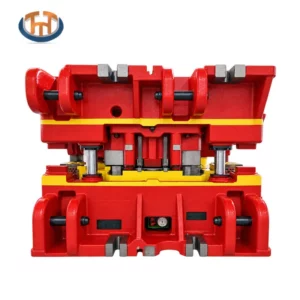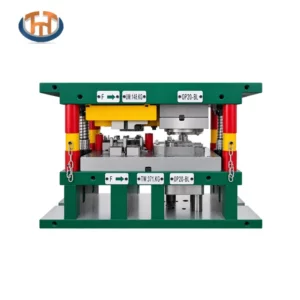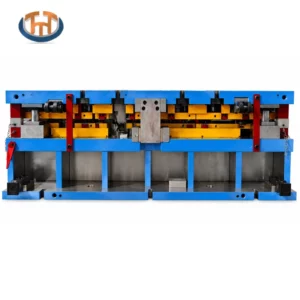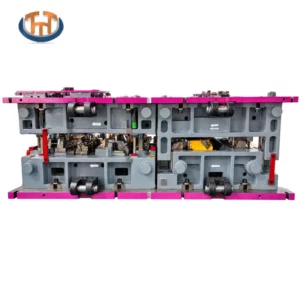

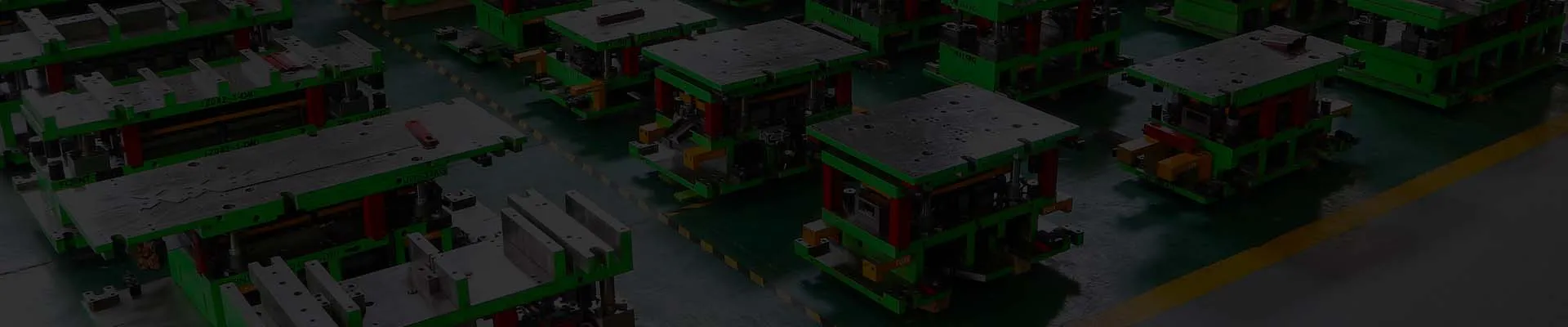
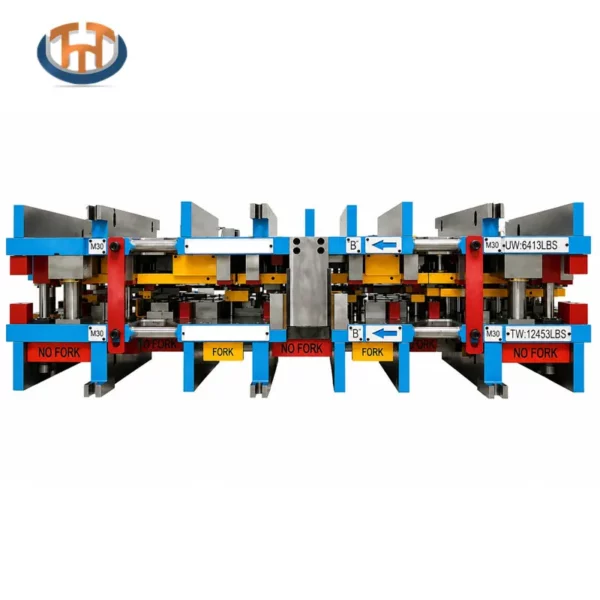
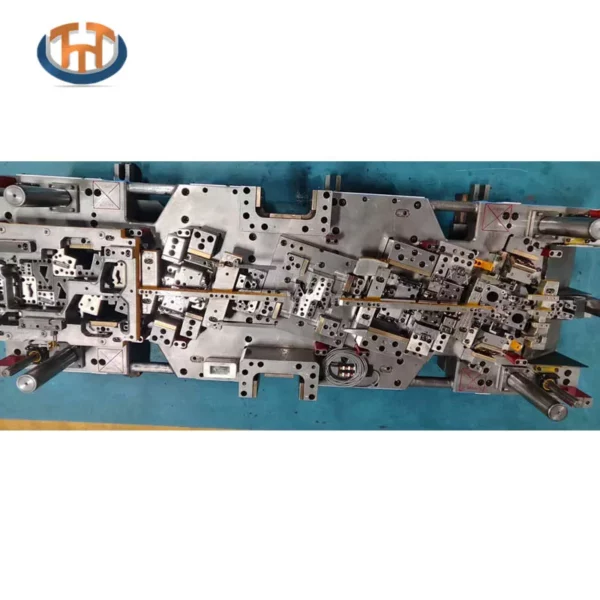
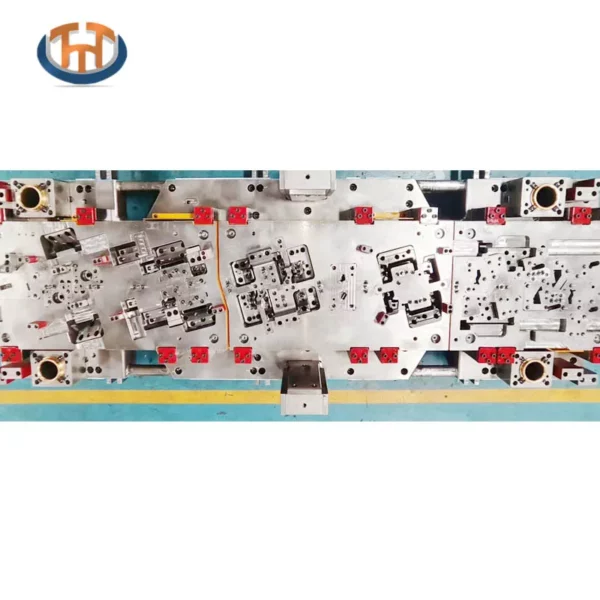
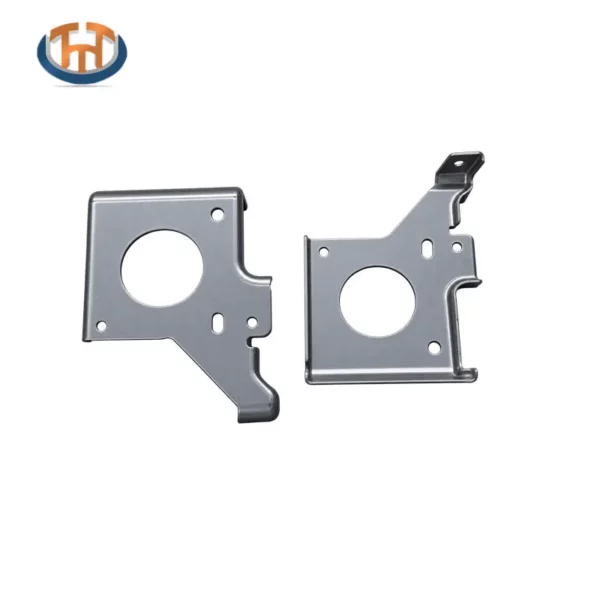
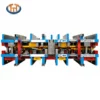
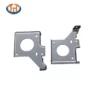
This heavy duty sheet metal stamping die was developed for the production of a large automotive cooler bracket. The tooling is designed for high-tonnage stamping operations where die size, structural rigidity, forming stability, and long-term production reliability are important.
The project involves a BRACKET, COOLER component manufactured from SHGA270C-45 material. The tooling has a die size of approximately 2700 × 850 × 713.4 mm, with an upper die weight of about 6,413 lb and a total tooling weight of approximately 12,453 lb.
The die is used with 600-ton and 1000-ton press applications, making it a representative example of HONGXING’s experience in manufacturing large and heavy automotive stamping dies.
Heavy-Duty Tooling for a Large Automotive Bracket
Large automotive brackets require considerably more than a simple forming surface. The stamping die must maintain sufficient rigidity while handling substantial forming forces and the weight of the tooling itself.
For this cooler bracket application, the die was developed around the actual component geometry and production requirements. The large die dimensions provide the working area required for the component, while the overall tooling structure is designed to withstand high press loads during production.
The 2700 mm × 850 mm × 713.4 mm tooling envelope also reflects the scale involved in manufacturing dies for larger automotive sheet metal components.
600T / 1000T Press Application
The stamping operation is associated with 600T and 1000T press capacities, depending on the production setup.
High-tonnage stamping places greater demands on the die structure than smaller automotive components. The tooling needs to maintain stable alignment and support the forming surfaces under substantial loads.
For this reason, heavy-duty die manufacturing requires attention to:
- Die structural strength
- Forming surface accuracy
- Guide and alignment performance
- Load distribution
- Die opening and closing stability
- Machining accuracy
- Assembly quality
These factors are considered during the manufacturing and assembly of the tooling rather than being treated only as final inspection requirements.
Tooling Size and Weight
The physical scale of this project is one of its defining characteristics.
| Item | Specification |
|---|---|
| Component | BRACKET, COOLER |
| Material | SHGA270C-45 |
| Die Size | 2700 × 850 × 713.4 mm |
| Upper Die Weight | Approx. 6,413 lb |
| Total Tooling Weight | Approx. 12,453 lb |
| Press Application | 600T / 1000T |
A total tooling weight of approximately 12,453 lb requires appropriate handling, machining, assembly, transportation, and production planning throughout the manufacturing process.
The tooling therefore represents not only a forming tool but also a large-scale manufacturing project requiring coordinated engineering and shop-floor execution.
Manufacturing Large Sheet Metal Stamping Dies
Manufacturing a large sheet metal stamping die involves several stages, from machining the die components to final assembly and dimensional verification.
For large automotive tooling, machining accuracy is particularly important because deviations in individual die components can affect the final assembly and forming condition.
HONGXING manufactures automotive stamping dies with consideration for the complete tooling structure, including machining, component fitting, assembly, adjustment, and inspection.
The objective is to deliver tooling that can be installed on the intended stamping equipment and used for repeatable production of the target component.
Application in Automotive Sheet Metal Forming
The cooler bracket is a functional automotive sheet metal component that requires a controlled forming process to achieve its intended geometry.
A dedicated automotive sheet metal stamping die allows the required forming features to be produced through a controlled stamping operation rather than relying on secondary fabrication methods.
The tooling therefore needs to correspond closely with the component’s three-dimensional geometry and the characteristics of the selected sheet material.
For production applications involving larger brackets and structural sheet metal components, die construction must take into account both the geometry of the component and the forming loads generated during stamping.
HONGXING Heavy-Duty Stamping Die Manufacturing
HONGXING focuses on the manufacturing of automotive stamping dies and tooling, including large dies used for automotive sheet metal components.
Our tooling projects cover different material grades, component geometries, die sizes, and press capacities. Large-scale projects such as this cooler bracket die require coordination between engineering, CNC machining, die assembly, fitting, and final verification.
Rather than treating heavy-duty tooling simply as a larger version of a conventional die, HONGXING considers the actual component, press capacity, tooling dimensions, and production requirements when manufacturing the die.
Custom Automotive Stamping Dies
The tooling shown on this page represents one specific heavy-duty automotive stamping application. Die dimensions, construction, forming operations, and press requirements can vary significantly from one component to another.
HONGXING can manufacture custom automotive stamping dies according to customer-provided part data, CAD models, drawings, material specifications, and production requirements.
For large automotive sheet metal components, the engineering and manufacturing process can be adapted to the required component geometry and stamping equipment.
Request a Quote for your automotive stamping die project and provide the available part drawings, 3D data, material information, and production requirements for evaluation.