

Introduction
Material cost is a major consideration in automotive sheet metal manufacturing. For components produced in large quantities, even a small improvement in material utilization can generate meaningful savings over the life of a production program.
However, reducing material consumption is not simply a matter of making the blank smaller. An effective automotive stamping die design must balance material utilization with forming quality, component strength, dimensional accuracy, production stability, and tooling maintenance requirements.
Poor strip layout decisions can increase scrap, create feeding difficulties, and compromise part quality. Conversely, a well-engineered tooling solution can improve material efficiency while maintaining reliable production performance.
For automotive OEMs and Tier 1 suppliers, material utilization should therefore be evaluated during the early engineering stage rather than treated as a production adjustment after the stamping die has been manufactured.
1. Understand Material Utilization in Automotive Stamping
Material utilization refers to the percentage of purchased sheet material that becomes usable finished components.
A basic calculation is:
Material Utilization (%) = Net Part Weight ÷ Total Material Input Weight × 100%
For progressive stamping, the calculation can also be based on the net blank area and the total strip area consumed per part, provided the material thickness and density are consistent.
For example, if the material consumed to produce one component weighs 2.5 kg and the finished part weighs 1.8 kg, the material utilization rate is 72%.
The remaining material may include skeleton scrap, trimmed edges, carrier material, and other process-related waste.
This calculation helps engineers compare different layout concepts and estimate potential material savings.
Nevertheless, the highest theoretical utilization rate does not always represent the best production solution. A layout must also satisfy forming requirements, strip strength, feeding stability, and the operational needs of the stamping press.

2. Optimize Strip Layout Design Before Manufacturing
Strip layout design is one of the most influential factors in material utilization, particularly for progressive dies.
A strip layout defines how the component is arranged across the sheet and how it moves through successive stamping stations.
During automotive stamping die design, engineers should evaluate the following factors:
- Part orientation: Determine whether rotating or changing the direction of the component can reduce unused material.
- Pitch distance: Optimize the distance between successive blanks while maintaining sufficient space for cutting and forming operations.
- Strip width: Minimize unnecessary side margins without compromising strip stability or feeding accuracy.
- Carrier design: Ensure that the remaining material provides adequate support as the strip travels through the die.
- Station sequence: Arrange piercing, notching, forming, trimming, and cutoff operations according to the component’s manufacturing requirements.
These factors should be considered together. For example, reducing the strip width may improve the theoretical utilization rate, but it can also weaken the carrier or make the strip more difficult to feed.
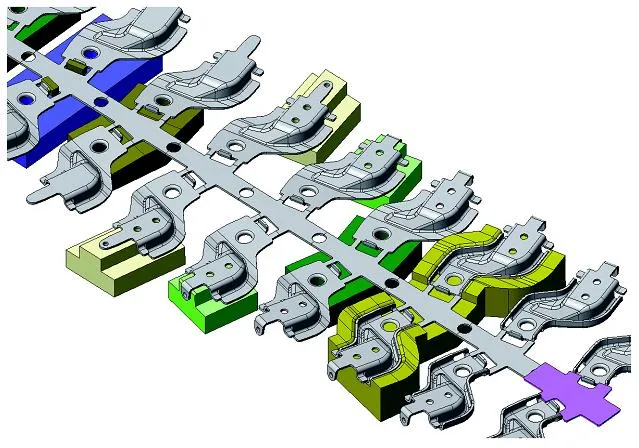
A successful strip layout is therefore the result of engineering optimization rather than simply minimizing the dimensions of the material.
For components requiring multiple forming stages, HONGXING’s automotive progressive die solutions can be evaluated according to part geometry, material specifications, press conditions, and production volume.
3. Select the Right Blank Arrangement
The arrangement of blanks on a sheet or strip has a direct impact on the amount of material left unused.
For suitable components, engineers may compare straight, rotated, or staggered arrangements to identify opportunities for reducing gaps between adjacent blanks.
The best arrangement depends on the geometry of the part.
For example, components with irregular outlines may leave substantial unused space when arranged in a single direction. Rotating or staggering the blanks may improve material utilization, provided the component’s grain direction, forming requirements, and downstream manufacturing constraints allow it.
However, not every component is suitable for nesting or rotation.
Automotive structural parts may require a particular material orientation to satisfy mechanical performance or forming requirements. Certain components also need dedicated carrier areas or sufficient edge material for reliable handling.
Before approving a layout, engineers should verify that the proposed arrangement maintains the required component quality and can be manufactured consistently.
The objective is to find a practical balance between material savings and production reliability.
4. Consider Material Properties and Forming Requirements
Material utilization cannot be optimized independently of material behavior.
Different automotive sheet materials have different strength, ductility, thickness, and forming characteristics. These differences influence the blank geometry, forming sequence, and tooling design.
For example, high-strength steel may require careful control of forming loads and deformation, while aluminum alloys may need additional attention to surface protection and material handling.
The selected blank shape must provide enough material for the intended forming process. Removing too much material in an effort to improve utilization may lead to insufficient flange dimensions, incomplete forming, edge cracking, or other quality problems.
Engineers should therefore consider the following before finalizing a blank layout:
- Material grade and thickness
- Part geometry and forming depth
- Flange dimensions and edge conditions
- Required mechanical performance
- Forming direction and deformation behavior
- Trimming allowance and dimensional tolerances
For demanding automotive applications, material utilization should be reviewed alongside forming feasibility and the overall production process.
HONGXING develops automotive structural stamping dies for vehicle body components and structural applications where material behavior, tooling strength, and dimensional requirements must be considered together.
5. Reduce Scrap Without Compromising Production Stability
Scrap reduction is another important part of an effective stamping material utilization strategy.
Unnecessary scrap can originate from excessive blank margins, inefficient strip layouts, oversized carriers, avoidable trimming operations, or unsuitable manufacturing sequences.
Engineers can review these areas during tooling development to identify potential improvements.
Review trimming allowances
Trimming allowances should be sufficient to accommodate the manufacturing process and achieve the specified component geometry. Excessive allowances may increase scrap, while insufficient allowances can result in incomplete trimming or unacceptable edges.
Evaluate scrap removal
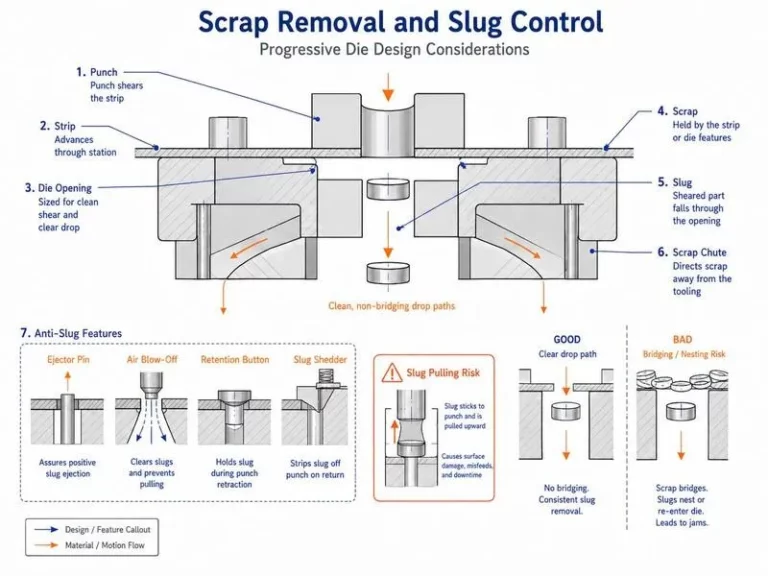
Scrap must be removed reliably from the die. Poor scrap management can cause material buildup, interference, unexpected press stoppages, or damage to tooling components.
Balance material savings and maintenance
A more compact strip layout may increase the complexity of certain die components or reduce access for cleaning and maintenance. These factors should be included when evaluating the total production cost.
Validate the proposed design
The final layout should be reviewed against manufacturing requirements, tooling constraints, and production conditions. Where appropriate, engineering simulation and trial production can help identify risks before the design is released.
A good solution minimizes unnecessary waste without introducing new quality or maintenance problems.
6. Use Engineering Analysis to Compare Layout Options
Modern tooling development can use CAD-based layout studies and, where appropriate, forming simulation to evaluate alternative manufacturing concepts.
Instead of selecting a strip layout based only on visual inspection, engineers can compare multiple proposals against measurable criteria.
A typical evaluation may include:
| Evaluation factor | Engineering objective |
|---|---|
| Material utilization | Reduce unnecessary material consumption |
| Strip width and pitch | Optimize material dimensions |
| Forming feasibility | Avoid cracks, wrinkles, and incomplete forming |
| Carrier stability | Maintain reliable material feeding |
| Die complexity | Control tooling cost and maintenance requirements |
| Production rate | Support the required manufacturing volume |
| Part quality | Meet dimensional and functional specifications |
The most suitable solution is not necessarily the layout with the highest material utilization percentage.
A slightly lower utilization rate may be preferable if it improves feeding stability, reduces die complexity, or prevents frequent production interruptions.
The decision should be based on the combined performance of the tooling and the production process.
7. Evaluate the Total Cost, Not Only the Scrap Rate
Material savings are important, but they represent only one part of the total cost of an automotive stamping project.
A layout that reduces material consumption may also require additional tooling components, more complicated machining, or longer setup times. These factors can affect the overall economic benefit.
A comprehensive evaluation should consider:
- Material cost per component
- Expected annual production volume
- Scrap and rework rates
- Tooling manufacturing and maintenance costs
- Press setup and changeover time
- Production downtime
- Expected tooling service life
For high-volume automotive production, small per-part savings can accumulate significantly over the program lifecycle.
For low-volume or highly complex components, engineering simplicity and production flexibility may be more valuable than achieving the maximum theoretical material utilization rate.
The best automotive stamping tooling solution should therefore support both efficient material consumption and dependable long-term production.
8. How HONGXING Approaches Material-Efficient Tooling Development
HONGXING, a member of TTM GROUP, specializes in automotive stamping die design and manufacturing for automotive manufacturers and Tier 1 suppliers.
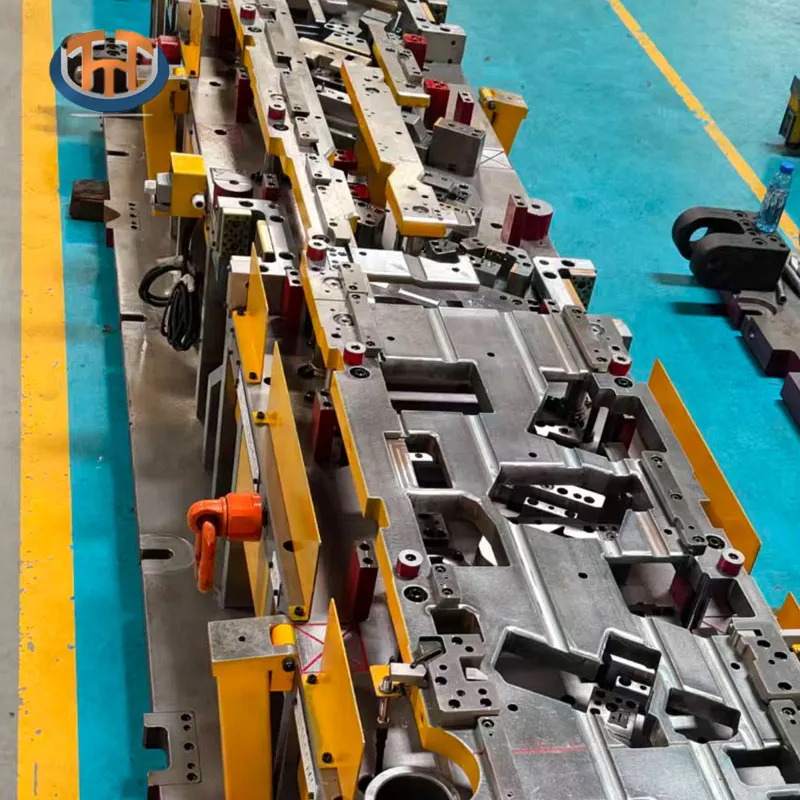
Our tooling capabilities include progressive dies, transfer dies, tandem dies, and customized stamping dies for automotive sheet metal components.
When developing a tooling solution, material utilization can be considered alongside part geometry, material specifications, press capacity, production volume, and manufacturing feasibility.
The engineering process may include:
- Reviewing component drawings and material specifications.
- Evaluating the proposed manufacturing process and blank requirements.
- Comparing strip layout and material arrangement options.
- Assessing forming feasibility and tooling constraints.
- Developing the stamping die design and manufacturing plan.
- Supporting machining, die assembly, tryout, and dimensional verification.
This integrated approach helps identify material-saving opportunities while maintaining the requirements for part quality, production stability, and tooling performance.
Explore our automotive stamping die manufacturing capabilities to learn more about HONGXING’s customized tooling solutions.
Conclusion
Optimizing material utilization in automotive stamping die design requires more than reducing blank dimensions. It involves coordinated decisions about strip layout, blank arrangement, material properties, trimming allowances, scrap removal, tooling complexity, and production requirements.
By evaluating these factors early in the engineering process, manufacturers can identify opportunities to reduce material waste without compromising component quality or production stability.
For automotive OEMs and Tier 1 suppliers, the most effective strategy is to combine material-efficient tooling design with practical manufacturing experience and systematic process validation.
HONGXING provides customized automotive stamping die solutions to support demanding sheet metal manufacturing applications.
Planning a new automotive stamping project? Contact HONGXING at ttm@ttmgauge.com to discuss your component drawings, material specifications, press requirements, and tooling development needs.