

Improving stamping production efficiency is an important goal for automotive manufacturers and metal forming companies. Efficient stamping production can help manufacturers increase output, reduce unnecessary downtime, control manufacturing costs, and maintain consistent part quality.
However, production efficiency is not determined by press speed alone. The actual performance of a stamping line depends on the interaction between tooling, equipment, material handling, process stability, maintenance, quality control, and production management.
For automotive stamping production, even small improvements in cycle time, setup time, downtime, scrap rate, or die maintenance can have a significant effect when multiplied across high-volume production.
This article explains practical ways to improve stamping production efficiency, from tooling preparation and press setup to automation, maintenance, quality monitoring, and production data analysis.
What Determines Stamping Production Efficiency?
Before improving production performance, manufacturers need to understand where production time and losses occur.
The main factors affecting stamping production efficiency include:
- Press cycle time
- Die setup and changeover time
- Material feeding performance
- Equipment availability
- Die condition
- Part quality
- Scrap rate
- Unplanned downtime
- Manual handling
- Maintenance frequency
A production line may have a high-speed press but still achieve poor overall efficiency if frequent die adjustments, material feeding problems, quality defects, or equipment stoppages interrupt production.
For this reason, efficiency improvement should focus on the complete production system rather than one individual machine.
1. Optimize Stamping Die Design Before Production
The die has a direct influence on production stability.
A well-engineered stamping die should not only produce the required part geometry but also support stable and repeatable production.
During tooling development, engineers can evaluate:
- Part manufacturability
- Material utilization
- Press requirements
- Die layout
- Material handling
- Part positioning
- Scrap removal
- Maintenance accessibility
- Automation requirements
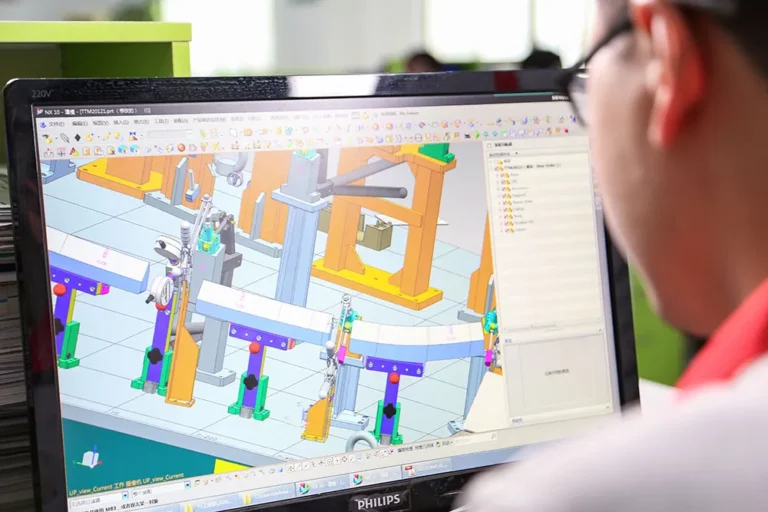
CAE simulation and engineering analysis can also help identify potential forming problems before the die enters production.
Early identification of tooling problems can reduce later modifications and shorten the time required for die tryout and production validation.
This is particularly important for automotive components because tooling changes after production launch can result in additional downtime and cost.
2. Reduce Die Setup and Changeover Time
Die changeover is an important source of production downtime.
When a stamping die is replaced, production may need to stop while operators perform several activities, including:
- Removing the previous die
- Installing the new die
- Connecting required systems
- Adjusting die position
- Checking press settings
- Confirming material feeding
- Performing initial trial strokes
- Inspecting the first parts
Manufacturers can improve efficiency by standardizing these activities.
Useful measures include:
- Standardized setup procedures
- Pre-production die preparation
- Clearly defined connection points
- Standardized locating systems
- Setup checklists
- Quick-change tooling arrangements
- First-piece inspection procedures
Reducing changeover time allows more available production time to be used for actual stamping.
3. Improve Material Feeding Accuracy
Material feeding directly affects production continuity.
In automated stamping lines, coil or sheet material must reach the die at the correct position and timing. Feeding deviations can cause incorrect part dimensions, misalignment, material damage, or production stoppages.
Manufacturers should monitor:
- Feeding distance
- Material positioning
- Feed timing
- Coil alignment
- Material surface condition
- Sensor performance
For high-volume production, stable automatic feeding can significantly reduce manual intervention.
The feeding system should also be properly synchronized with the press and tooling to maintain consistent production cycles.
4. Optimize Press Operating Parameters
Press parameters should be selected according to the material, tooling requirements, component geometry, and production conditions.
Important parameters may include:
- Press speed
- Stroke length
- Press force
- Slide motion
- Feed timing
- Lubrication conditions
Increasing press speed does not automatically increase overall production efficiency.
If excessive speed causes quality problems, die wear, material feeding errors, or frequent stoppages, the additional output may be offset by increased downtime and scrap.
The objective should therefore be stable production at an appropriate operating speed, rather than simply maximizing press speed.
5. Use Automation to Reduce Manual Operations
Automation can improve the consistency and repeatability of stamping production.
Depending on the production system, automation may include:
- Automatic coil feeding
- Robotic part handling
- Automatic loading and unloading
- Transfer systems
- Automated scrap removal
- In-line inspection
- Production monitoring
Automation reduces repetitive manual operations and can also improve operator safety.
For high-volume automotive manufacturing, automated material handling allows production equipment to operate with fewer interruptions and more consistent cycle times.
However, automation should be designed around the actual production requirements. The objective is not to automate every operation, but to eliminate unnecessary manual handling and improve overall production flow.
6. Reduce Unplanned Stamping Downtime
Unplanned downtime can have a significant effect on production output.
Common causes include:
- Die damage
- Tool wear
- Press malfunction
- Feeding problems
- Sensor failures
- Lubrication problems
- Material positioning errors
- Quality abnormalities
Manufacturers can reduce unexpected stoppages by monitoring equipment and tooling conditions.
A useful maintenance strategy combines:
Preventive Maintenance + Condition Monitoring + Production Data
Instead of waiting for a component to fail, maintenance teams can inspect critical tooling and equipment at defined intervals.
Early detection of abnormal wear or equipment behavior allows corrective action to be taken before a major production interruption occurs.
7. Maintain Stamping Dies Properly
A stamping die operates under repeated mechanical loads. Over time, working surfaces, cutting components, guide components, springs, nitrogen systems, and other parts may experience wear.
Poor die condition can lead to:
- Dimensional variation
- Burrs
- Surface defects
- Part deformation
- Increased adjustment time
- Unexpected downtime
A structured die maintenance program should include:
- Regular visual inspection
- Wear inspection
- Cleaning
- Lubrication
- Fastener inspection
- Alignment checks
- Replacement of worn components
- Dimensional verification
Proper maintenance helps maintain stable production and can also extend stamping die service life.
8. Improve First-Piece Validation
First-piece inspection is an important control point after die installation, changeover, adjustment, or maintenance.
Instead of allowing production to continue while quality problems develop, manufacturers can verify critical characteristics before releasing the process for mass production.
Depending on the component, inspection may include:
- Overall dimensions
- Hole positions
- Formed surfaces
- Flange geometry
- Critical tolerances
- Surface condition
Checking fixtures and CMM measurement systems can be used for dimensional verification when required.
Early identification of deviations reduces the possibility of producing large quantities of nonconforming parts.
9. Reduce Scrap and Rework
Production efficiency is not only about how many parts are produced.
A line producing a large quantity of parts with a high scrap rate may have lower effective productivity than a stable line with a slightly lower output but significantly better quality.
Manufacturers should monitor:
- Scrap rate
- Rework rate
- Defect types
- Material waste
- First-pass yield
Common sources of stamping defects may include incorrect material positioning, tooling wear, improper setup, material variation, or unstable process conditions.
By identifying the most frequent defects and addressing their root causes, manufacturers can improve both production efficiency and material utilization.
10. Monitor Production Data
Production data provides useful information for identifying efficiency losses.
Manufacturers can track indicators such as:
- Actual cycle time
- Planned production time
- Downtime
- Changeover time
- Scrap quantity
- Rework quantity
- Maintenance frequency
- Die service intervals
- Production output
For example, if a stamping line repeatedly stops because of material feeding problems, the production data can reveal the frequency and duration of these interruptions.
This allows engineers and production managers to focus improvement efforts on the actual bottlenecks rather than relying only on assumptions.
11. Improve Coordination Between Tooling and Production Teams
Stamping production efficiency is influenced by decisions made before mass production begins.
Tooling engineers, manufacturing engineers, maintenance teams, quality engineers, and production operators should therefore work together.
Important information should be shared throughout the tooling and production stages, including:
- Die design considerations
- Production requirements
- Press specifications
- Material information
- Known tooling risks
- Maintenance requirements
- Quality issues
- Production feedback
Feedback from production can also be used to improve future tooling projects.
This creates a continuous improvement cycle from tool design to manufacturing, tryout, production, maintenance, and optimization.
12. Use a Balanced Efficiency Strategy
A common mistake is to focus on a single performance indicator, such as press speed.
In reality, effective production performance depends on several factors working together.
A balanced improvement strategy should consider:
Higher Output + Lower Downtime + Lower Scrap + Stable Quality + Longer Tool Life
For example, increasing press speed may increase theoretical output, but if it also increases die wear or defect rates, the overall production result may not improve.
The best production strategy is therefore one that maintains stable operation while improving the efficiency of the complete manufacturing system.
Key Performance Indicators for Stamping Production
Manufacturers can use several key performance indicators to evaluate stamping production efficiency.
| Performance Indicator | What It Measures |
|---|---|
| Cycle Time | Time required to complete one production cycle |
| Downtime | Time when the production line is unavailable |
| Changeover Time | Time required to replace and prepare tooling |
| Scrap Rate | Percentage of produced parts rejected |
| Rework Rate | Percentage of parts requiring additional work |
| Production Output | Quantity of acceptable parts produced |
| Die Maintenance Frequency | Frequency of tooling maintenance |
| First-Pass Yield | Percentage of parts accepted without rework |
Tracking these indicators over time makes it easier to determine whether production improvements are generating measurable results.
Building a More Efficient Automotive Stamping Line
Improving stamping production efficiency is a continuous process rather than a one-time adjustment.
The most effective approach combines:
- Optimized tooling design
- Accurate die manufacturing
- Efficient die setup
- Stable material feeding
- Appropriate press parameters
- Production automation
- Preventive maintenance
- Effective quality control
- Production data analysis
- Continuous process improvement
These elements work together to create a more stable and productive stamping operation.
For automotive manufacturers, the goal should be to achieve consistent production performance rather than simply increasing machine speed.
HONGXING Automotive Stamping Die Solutions
HONGXING, a member of TTM Group, specializes in automotive stamping die design and manufacturing for automotive manufacturers and Tier 1 suppliers.
Its tooling capabilities cover automotive structural components, body panels, reinforcement parts, brackets, and other sheet metal applications.
The tooling development process can include product analysis, process planning, die design, CNC machining, die assembly, tryout, adjustment, and production validation.
By considering production requirements from the early engineering stage, tooling development can support stable mass production, dimensional consistency, efficient maintenance, and reliable production performance.
Conclusion
Improving stamping production efficiency requires more than increasing press speed.
A productive automotive stamping operation depends on reliable tooling, accurate material feeding, efficient setup, appropriate machine parameters, automation, preventive maintenance, quality control, and continuous monitoring.
Manufacturers can improve overall performance by reducing unnecessary downtime, minimizing scrap and rework, shortening changeover time, and maintaining stable tooling conditions.
For high-volume automotive production, these improvements can accumulate into significant gains in production capacity and manufacturing efficiency.
A well-designed stamping system should therefore be evaluated as a complete production process, from tooling development and material handling to mass production, inspection, maintenance, and continuous improvement.