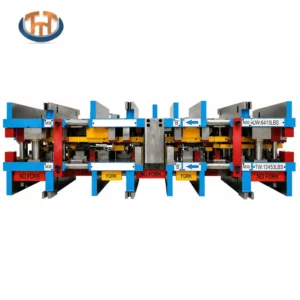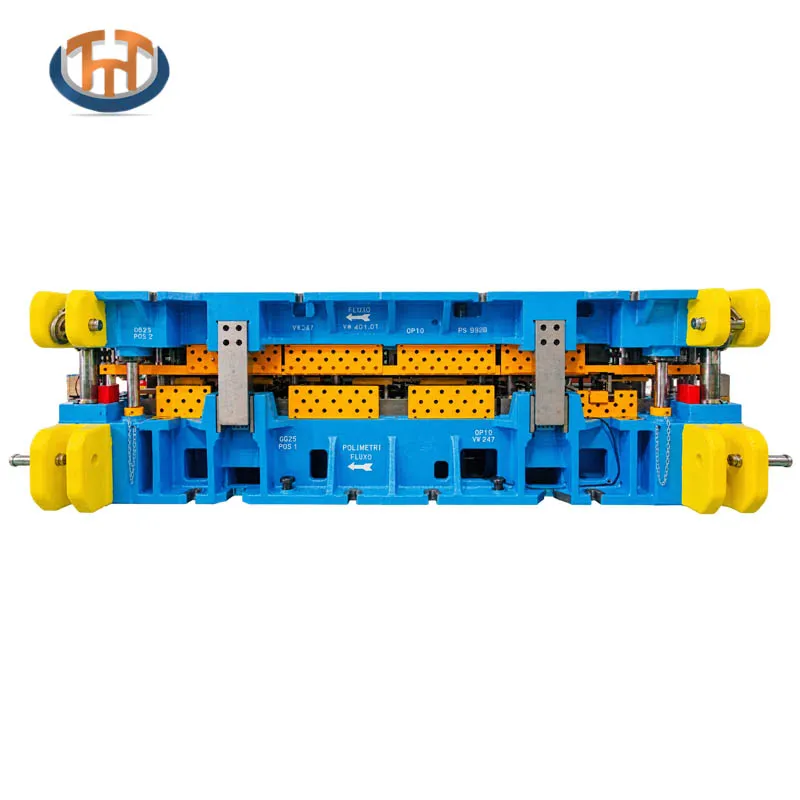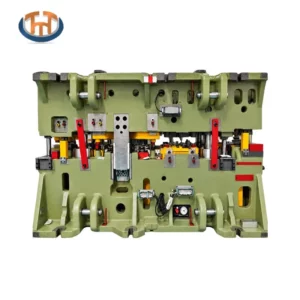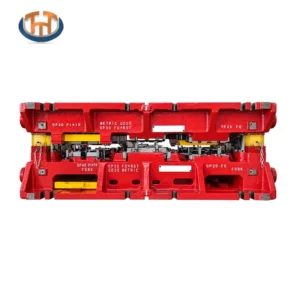

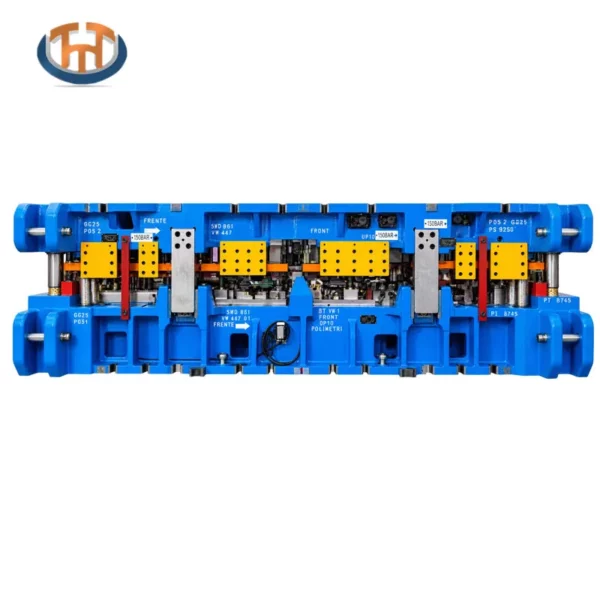
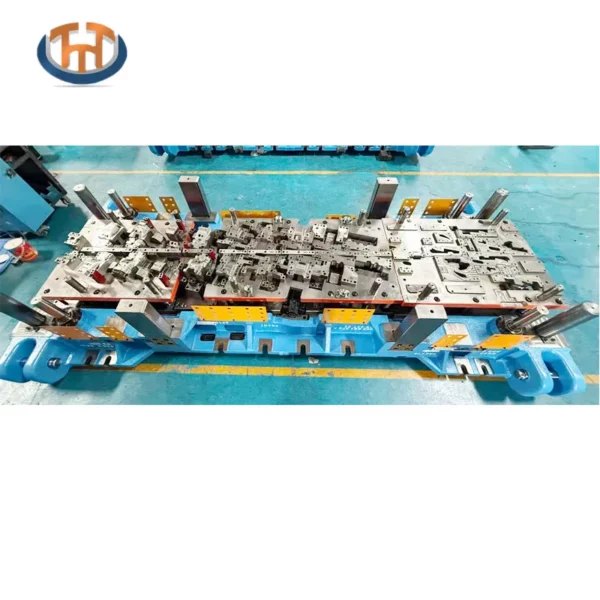
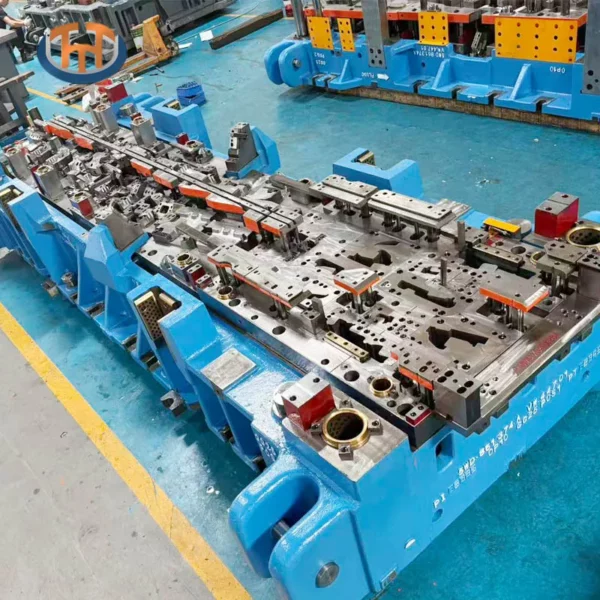
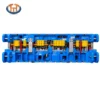
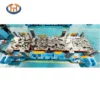
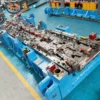
This Heavy-Duty Automotive Stamping Die is engineered for the precision forming of automotive sheet metal components, specifically a rear mounting bracket or clip angle used in an automotive body structure. Designed for demanding production environments, the tooling combines a rigid die structure, accurate locating features, controlled forming surfaces, and reliable process performance to support consistent high-volume manufacturing.
The Heavy-Duty Automotive Stamping Die shown in the production photograph is a large-scale automotive tool manufactured with a robust cast and machined construction. Its substantial structure is designed to withstand high forming forces while maintaining accurate movement between the upper and lower die assemblies. This makes the tooling suitable for automotive applications where dimensional stability, repeatability, and long-term production reliability are essential.
Heavy-Duty Automotive Stamping Die for Rear Mounting Brackets
According to the engineering drawing, the stamped component is identified as a rear clip angle. The specified material is DIN EN 10130-DC03, with a nominal material thickness of 2.0 mm. The finished component incorporates four M6 weld nuts, allowing it to be integrated into subsequent automotive assembly operations.
The component includes several controlled geometric features, including circular holes, an oblong hole, square reference surfaces, and locating features. The RPS system establishes reference points for controlling the position of important features during manufacturing and inspection.
The drawing identifies an Ø8 circular hole, an oblong hole, and square reference surfaces as part of the controlled reference system. Additional locating features include Ø6.5 circular holes. These features are important because they allow the stamped component to be accurately positioned during subsequent assembly and inspection operations.
For automotive structural components, accurate positioning is particularly important. Small variations in hole location, trim edges, or forming surfaces can affect the fit of the component during assembly. The tooling therefore needs to provide stable forming conditions and repeatable positioning throughout the production cycle.
Heavy-Duty Tooling Construction
The Heavy-Duty Automotive Stamping Die is designed as a substantial heavy-duty production die for automotive sheet metal forming. The specifications marked on the die indicate an approximate overall size of 4068 × 1845 × 950 mm, an upper die weight of approximately 9,722 kg, and a total die weight of approximately 19,040 kg.
The indicated press capacity is 800 tons, demonstrating the substantial forming capability required for this tooling application.
Heavy-Duty Automotive Stamping Die body provides the rigidity required to maintain stable forming conditions for the 2.0 mm steel component. A rigid structure helps minimize unwanted movement and deformation of the tooling during forming, which is especially important for large automotive dies operating under high loads.
The upper and lower die assemblies must work together accurately throughout the forming stroke. Proper machining, guide systems, fitting, and assembly are therefore essential to achieving stable part quality.
Precision Forming and RPS Position Control
Precision is a critical consideration when manufacturing tooling for automotive structural sheet metal components. The engineering drawing defines dimensional and surface requirements based on established RPS systems and reference data.
The RPS system provides a controlled method for establishing the position of critical component features. By using defined reference holes, surfaces, and locating points, manufacturers can maintain consistent relationships between the stamped component and the vehicle assembly structure.
The Heavy-Duty Automotive Stamping Die must therefore be manufactured and assembled according to the engineering data, with particular attention to:
- Critical locating features
- Hole positions
- Forming surfaces
- Trim edges
- Reference surfaces
- Die alignment
- Component repeatability
Accurate machining and careful die fitting help ensure that the upper and lower tooling assemblies maintain the required relationship during production. Inspection of critical features after machining and tryout further helps identify potential dimensional deviations before the tool is released for production.
Manufacturing Process
Manufacturing a large automotive die involves multiple engineering and production stages. For a tool of this size and weight, each stage must be carefully coordinated to maintain dimensional accuracy and tooling performance.
The typical manufacturing process includes:
1. Tooling Engineering
The manufacturing team reviews the customer part data, material specifications, forming requirements, RPS information, and production requirements before finalizing the tooling design.
2. CNC Machining
Major die components are machined using CNC equipment according to the approved CAD data. Accurate machining of forming surfaces, locating areas, mounting surfaces, and functional features is essential for final die performance.
3. Die Fitting and Assembly
After machining, individual components are fitted and assembled. The fitting process ensures that mating surfaces, guide systems, inserts, and forming elements work correctly together.
4. Tryout
The completed Heavy-Duty Automotive Stamping Die is installed on an appropriate press for tryout. During this stage, engineers evaluate forming behavior, material flow, trimming conditions, dimensional accuracy, and surface quality.
5. Dimensional Inspection
Stamped samples are inspected against the engineering requirements. Critical holes, reference features, surfaces, trim edges, and other controlled dimensions are checked to verify that the tool produces acceptable parts.
6. Final Validation
After necessary adjustments, the tooling undergoes final validation before shipment or production release.
This controlled process helps reduce dimensional variation and provides greater confidence in long-term production performance.
Application in Automotive Manufacturing
This type of tooling is suitable for manufacturing automotive sheet metal brackets and structural components that require accurate forming and repeatable positioning.
Typical applications include:
- Rear mounting brackets
- Rear clip angles
- Automotive structural brackets
- Body-in-white components
- Reinforcement brackets
- Automotive sheet metal supports
- Components with precision locating holes
- Components requiring weld-nut installation
The stamped component in this project includes four M6 weld nuts. Depending on the customer’s manufacturing process, weld-nut installation can be integrated into a subsequent production operation such as projection welding or other joining processes.
The combination of forming accuracy and controlled locating features makes this type of tooling suitable for components that must maintain a consistent relationship with surrounding automotive structures.
Heavy-Duty Automotive Stamping Die Quality Control and Production Reliability
Quality control is an important part of manufacturing an automotive stamping tool. Heavy-Duty Automotive Stamping Die can contain numerous machined and fitted components, meaning that dimensional deviations in individual components may influence the final stamped part.
HONGXING applies inspection and quality-control procedures throughout the tooling manufacturing process. Machined components can be checked before assembly, while completed tooling can be evaluated through tryout and stamped-part inspection.
Part inspection focuses on critical areas such as:
- Hole location
- RPS reference features
- Formed surfaces
- Trim edges
- Component geometry
- Dimensional tolerances
- Assembly-related features
The engineering drawing also indicates that unspecified geometric information should be obtained from the corresponding CAD data. This highlights the importance of maintaining consistency between the tooling, engineering drawing, and digital product data throughout the manufacturing process.
HONGXING Automotive Tooling Manufacturing
HONGXING provides integrated tooling manufacturing capabilities covering tooling engineering, CNC machining, die fitting, assembly, tryout, dimensional inspection, and production validation.
For large automotive stamping projects, our manufacturing approach focuses on structural rigidity, machining accuracy, forming stability, and repeatable production performance. Engineering and manufacturing teams coordinate the tooling process from initial design review through final validation.
The company can support projects involving automotive brackets, structural sheet metal components, reinforcement parts, mounting components, and other precision-formed automotive parts.
For customers with large and demanding tooling requirements, HONGXING can develop customized tooling solutions based on part drawings, 3D CAD data, material specifications, production volumes, press requirements, and quality standards.
Customized Automotive Stamping Tooling
Every automotive stamping project has different requirements related to material, thickness, geometry, production volume, press capacity, and dimensional tolerances. For this reason, tooling design and manufacturing need to be adapted to the specific component and production process.
HONGXING works with customer engineering data to develop tooling suitable for the required production conditions. The manufacturing process can include engineering review, CAD-based tooling development, CNC machining, component fitting, assembly, tryout, inspection, and final approval.
For large structural components, particular attention is given to die rigidity, forming stability, accurate positioning, and serviceability. These factors help improve tooling reliability and maintain consistent part quality throughout production.
Why Choose HONGXING
HONGXING combines engineering, machining, die assembly, tryout, and inspection capabilities to support automotive tooling projects from development through production validation.
Our capabilities include:
- Automotive stamping die design
- Heavy-duty tooling manufacturing
- Large-scale CNC machining
- Precision die fitting
- Die assembly and adjustment
- Tryout and process verification
- Dimensional inspection
- Automotive sheet metal tooling
- Customized tooling solutions
With appropriate engineering data and production requirements, HONGXING can manufacture tooling for both conventional automotive sheet metal applications and demanding structural components.
If you are sourcing a Heavy-Duty Automotive Stamping Die for a rear mounting bracket, structural reinforcement, body-in-white component, or other automotive sheet metal application, HONGXING can provide a customized tooling solution based on your drawings, CAD data, material specifications, and production requirements.