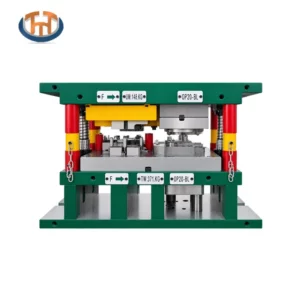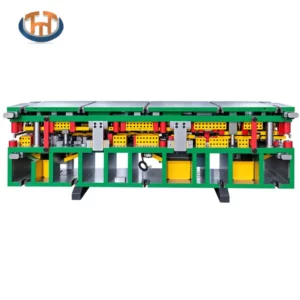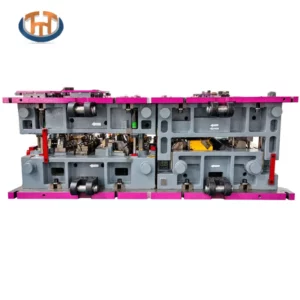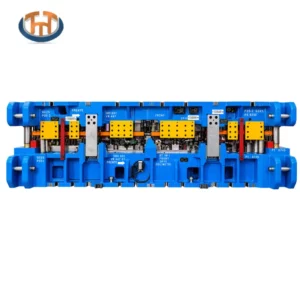


Single Hit Dies are widely used in automotive sheet metal production for manufacturing individual components through dedicated stamping operations. Unlike multi-stage tooling systems, a single hit die is designed to perform a specific stamping operation in a controlled press stroke, making it a practical solution for many forming, trimming, piercing, bending, and other sheet metal applications.
For automotive manufacturers and Tier 1 suppliers, properly designed Single Hit Dies can provide reliable part quality, flexible production arrangements, and efficient tooling maintenance. When combined with precision machining, accurate assembly, and systematic tryout, single-operation tooling can achieve the dimensional consistency required for demanding automotive production.
What Are Single Hit Dies?
Single Hit Dies, also known as Single Operation Dies or single-operation stamping dies, are stamping tools designed to perform a specific manufacturing operation during one press stroke.
Depending on the part design and production requirements, a single hit die can be developed for operations such as:
- Forming
- Trimming
- Piercing
- Bending
- Flanging
- Drawing
- Hole making
- Local forming
The exact operation depends on the geometry of the stamped component and the customer’s production process.
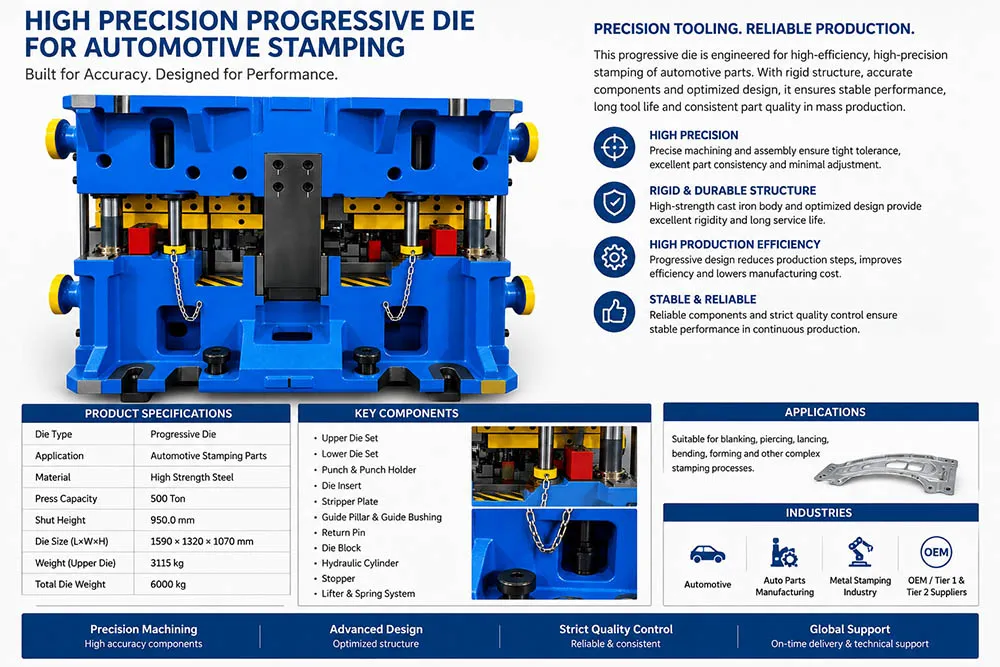
A typical single hit die consists of an upper die assembly, lower die assembly, working inserts, forming or trimming components, guide components, positioning elements, and supporting structures.
Because each die is normally dedicated to a particular operation, the tooling can be designed around the specific geometry and functional requirements of the component.
Single Hit Dies for Automotive Applications
Automotive manufacturing is one of the major application areas for Single Hit Dies.
Automotive sheet metal components often require multiple manufacturing operations before the final component is completed. Depending on the production strategy, individual forming, trimming, piercing, or bending operations can be performed using dedicated single-operation tooling.
Typical applications may include:
- Automotive body components
- Structural sheet metal parts
- Reinforcement components
- Brackets
- Supports
- Inner panels
- Outer body components
- Automotive sheet metal parts
For complex components, several Single Hit Dies can be arranged as a sequence of manufacturing operations. This provides flexibility when different stages require different forming or trimming conditions.
Precision Manufacturing of Single Hit Dies
The quality of Single Hit Dies depends heavily on the accuracy of the individual components and working surfaces.
Precision machining is used to manufacture important tooling components according to engineering drawings and 3D CAD data. CNC milling, drilling, grinding, wire EDM, and other machining processes may be selected according to the geometry and tolerance requirements.
Accurate machining helps control:
- Die component dimensions
- Forming surface geometry
- Hole locations
- Trim profiles
- Alignment
- Guide positions
- Assembly relationships
For automotive applications, maintaining dimensional accuracy throughout machining and assembly is particularly important because the final stamped component must meet the customer’s product requirements.
Forming and Trimming Performance
One important application of Single Hit Dies is forming and trimming.
Forming operations create the required three-dimensional geometry of the sheet metal component, while trimming removes excess material and establishes the required part boundary.
The technical documentation supplied for this tooling includes requirements related to surface, trim, hole position, and RPS.
The drawing also specifies a ±1.0 mm trim-line tolerance due to the Polimetri process.
These requirements provide important references for tooling development, machining, assembly, tryout, and final inspection.
Single Operation Dies and Production Flexibility
One of the main advantages of Single Operation Dies is production flexibility.
When each operation is handled by dedicated tooling, engineers can optimize individual processes according to the characteristics of the component.
For example, one operation may be dedicated to forming, while another may perform trimming or piercing. This allows manufacturers to make adjustments to individual processes without redesigning an entire multi-stage tooling system.
Single-operation tooling can therefore be useful for:
- Complex forming sequences
- Low- to medium-volume production
- Large automotive components
- Components requiring dedicated operations
- Tooling projects requiring flexible process arrangements
- Production programs with different press requirements
The most appropriate tooling solution should always be determined according to part geometry, material, production volume, press capacity, and manufacturing strategy.
Robust Tool Structure
A production Single Hit Die must withstand repeated press operations while maintaining accurate alignment between the upper and lower assemblies.
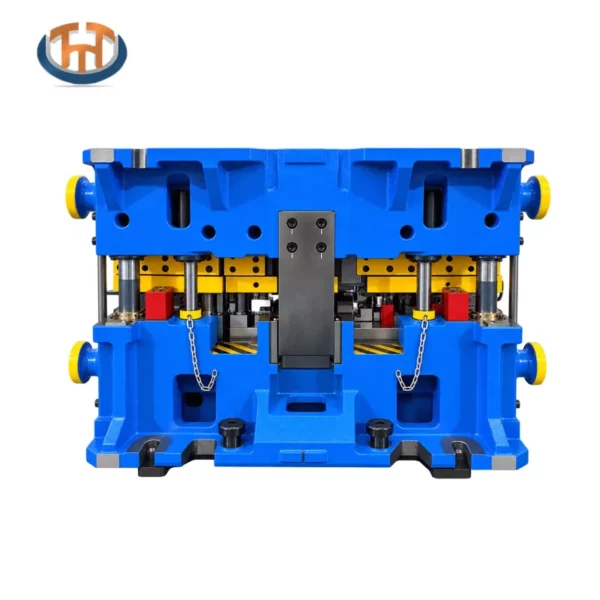
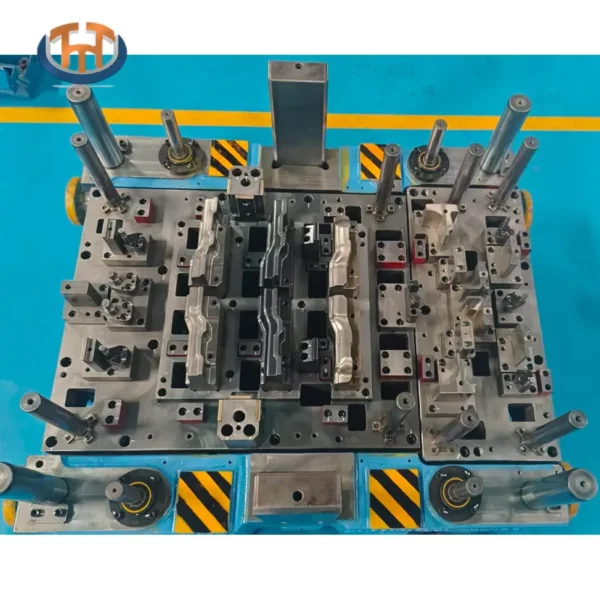
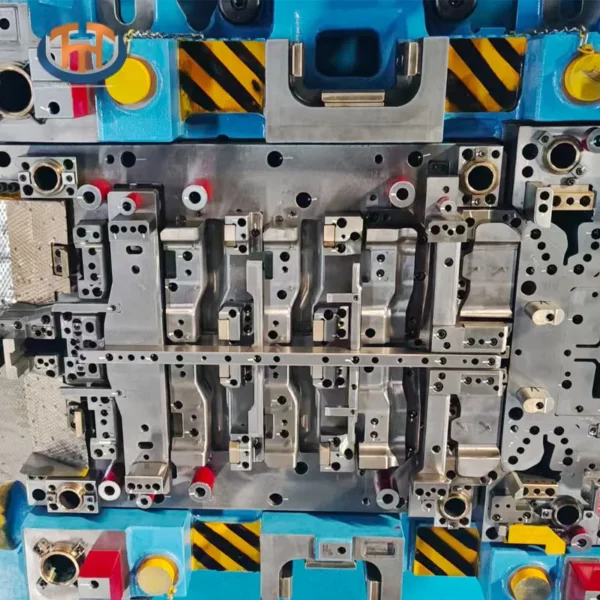
The tooling shown in the supplied product images features a large, rigid structure with multiple guide components, working areas, supporting elements, and heavy-duty die construction.
The identification plate visible on the tooling indicates a 500-ton press requirement, a die size of approximately 1590 × 1320 × 1070 mm, an upper die weight of approximately 3,115 kg, and a total die weight of approximately 6,000 kg. The plate also identifies the material as CR240LA G160/60-U and lists a shut height of 950.0 mm.
These specifications demonstrate the substantial scale of this particular automotive stamping tooling project.
Technical Data
| Item | Specification |
|---|---|
| Tool Type | Single Hit Die / Single Operation Die |
| Application | Automotive Stamping |
| Press Tonnage | 500 Ton |
| Die Size | Approx. 1590 × 1320 × 1070 mm |
| Upper Die Weight | Approx. 3115 kg |
| Total Die Weight | Approx. 6000 kg |
| Shut Height | 950.0 mm |
| Material | CR240LA G160/60-U |
| Main Quality Requirements | Surface / Trim / Hole Position / RPS |
| Trim Line Tolerance | ±1.0 mm |
The technical drawing also references raw material specifications and a separate 3D document for additional product information.
Quality Control for Single Hit Dies
Quality control is an important part of the Single Hit Dies manufacturing process.
Before the tooling is released for production, key areas can be evaluated according to customer drawings, CAD data, inspection requirements, and stamping trial results.
Typical inspection areas include:
Surface
Forming surfaces are checked against the required product geometry to help ensure that the stamped component achieves the intended shape.
Trim
Trim edges and trim lines are inspected according to the specified requirements. For the supplied tooling, the technical documentation identifies a ±1.0 mm trim-line tolerance related to the production process.
Hole Position
Hole locations are controlled to ensure that the finished component can meet downstream assembly requirements.
RPS
RPS references provide important positioning information for controlling the location and orientation of the stamped component. The technical documentation specifically identifies RPS-related requirements.
Tryout and Adjustment
Machining accuracy alone does not determine the final performance of Single Hit Dies.
After assembly, the tooling normally requires a stamping tryout to evaluate the actual production results.
Engineers may check:
- Part dimensions
- Forming accuracy
- Trim quality
- Hole position
- Surface condition
- Wrinkling
- Cracking
- Springback
- Die alignment
If adjustments are required, the forming or trimming areas can be corrected through machining, grinding, polishing, or controlled manual fitting.
This combination of precision machining, die assembly, tryout, and adjustment helps achieve stable production performance.
Single Hit Dies vs. Other Stamping Dies
Different stamping applications require different tooling strategies.
Single Hit Dies are generally designed around individual operations, making them flexible and relatively straightforward to adapt to specific production requirements.
By comparison, progressive dies combine multiple operations into one continuous stamping process, while tandem or transfer tooling can be used for larger components and more complex production sequences.
The choice between Single Hit Dies, progressive dies, and other tooling solutions depends on:
- Part geometry
- Material
- Production volume
- Press availability
- Number of operations
- Component size
- Required production efficiency
- Investment requirements
Therefore, there is no single tooling solution suitable for every automotive stamping project.
Custom Single Hit Dies
Every automotive component has different requirements. For this reason, custom Single Hit Dies are developed according to customer-specific part data and production conditions.
The tooling development process can include:
Product Data → Tooling Engineering → 3D Design → CAM Programming → CNC Machining → Component Inspection → Die Assembly → Tryout → Correction → Final Inspection
Using customer CAD data and engineering requirements as the foundation allows the tooling to be developed around the actual production application.
The supplied technical documentation specifically references GD&T information contained in the CATPart mathematical data, demonstrating the importance of digital product data in tooling development.
Reliable Automotive Stamping Tooling
For automotive manufacturers, reliable tooling is essential for maintaining consistent production.
Well-designed Single Hit Dies can provide a practical solution for dedicated forming, trimming, piercing, bending, and other stamping operations.
When tooling design, machining, assembly, inspection, and tryout are properly coordinated, manufacturers can improve dimensional consistency while reducing unnecessary production adjustments.
This is particularly important for automotive suppliers working with strict quality requirements and high-volume production environments.
Conclusion
Single Hit Dies provide a flexible and reliable tooling solution for automotive sheet metal stamping. By focusing on individual forming, trimming, piercing, bending, or other operations, these tools can be optimized for specific component requirements and production conditions.
The supplied tooling demonstrates a heavy-duty automotive stamping application with a 500-ton press requirement and substantial die dimensions and weight. Its technical documentation includes specific requirements for surface, trim, hole position, and RPS control.
For manufacturers looking for Single Hit Stamping Dies, the combination of accurate tooling design, precision machining, professional assembly, controlled tryout, and systematic inspection is essential for achieving reliable production performance.