

Stainless steel stamping is widely used to manufacture precision metal components for automotive, electronics, electrical equipment, medical devices, appliances, and industrial applications. Stainless steel offers excellent corrosion resistance, high strength, attractive surface quality, and good durability. However, these advantages also make stainless steel more challenging to process than many conventional sheet metals.
For manufacturers, achieving stable production requires more than simply selecting a suitable stamping press. Material properties, die design, forming processes, tooling materials, lubrication, springback, surface protection, and production control must all be considered. Understanding the major challenges of stainless steel stamping is essential for producing high-quality components with consistent dimensions and appearance.
1. High Material Strength Creates Greater Forming Resistance
One of the most important challenges in stainless steel stamping is its relatively high strength. Stainless steel grades such as 304 and 316 can require significantly higher forming forces than softer materials.
Higher material strength increases the load applied to the stamping die and press. If the tooling is not properly designed, excessive forming force may result in premature die wear, cracking, deformation, or unstable production.
Before manufacturing begins, engineers need to evaluate the material grade, thickness, tensile strength, yield strength, and forming characteristics. The selected press must provide sufficient capacity while maintaining an appropriate safety margin.
For complex components, the forming sequence may also need to be divided into multiple operations rather than completing the entire shape in one stroke. This approach can reduce local stress and improve dimensional stability.
2. Work Hardening Can Affect Forming Performance
Stainless steel has a strong tendency toward work hardening. When the material is repeatedly deformed, its hardness and strength can increase.
This characteristic creates additional challenges during stainless steel stamping, particularly when a component requires several forming operations. A material that was relatively easy to form during the first operation may become significantly harder during subsequent operations.
Work hardening can increase the risk of cracking in areas subjected to repeated deformation. Engineers therefore need to carefully determine the forming sequence and avoid unnecessary deformation in the same area.
Proper process planning is particularly important for deep-drawn or highly formed components. The goal is to distribute deformation as evenly as possible while preventing excessive strain concentration.
3. Springback Makes Dimensional Control More Difficult
Springback is another important issue in stainless steel stamping. After the stamping force is released, the material attempts to partially return toward its original shape.
Because stainless steel has relatively high strength and elasticity, springback can be significant, especially in bending and forming applications. The final component may therefore deviate from the intended dimensions of the stamping die.
To control springback, tooling engineers may use compensation in the die design. Over-forming, restriking, and additional calibration operations can also be used when necessary.
For precision components, springback should be considered during the initial die design stage rather than treated as a problem only after trial production.
4. Die Wear and Tooling Life
The high strength and hardness of stainless steel can accelerate die wear. During production, the contact between the sheet material and tooling generates friction and mechanical stress.
In stainless steel stamping, die material selection is therefore particularly important. High-quality tool steels and appropriate heat treatment can significantly improve wear resistance and extend tooling life.
The cutting edges also require careful design. Insufficient clearance can increase cutting force and accelerate edge wear, while excessive clearance may produce poor cut quality and burrs.
Regular inspection and preventive maintenance are essential for maintaining consistent production quality.
5. Burrs and Edge Quality
Cutting and punching stainless steel can produce burrs if the die clearance, cutting edge condition, or material properties are not properly controlled.
Excessive burrs can create problems during assembly and may also affect operator safety. In automotive and precision industrial applications, edge quality can be especially important.
A properly engineered stainless steel stamping die should consider material thickness, grade, cutting clearance, punch geometry, and die-edge condition.
When necessary, secondary deburring or edge-finishing processes can be introduced. However, optimizing the stamping process itself is generally preferable because it reduces additional processing costs.
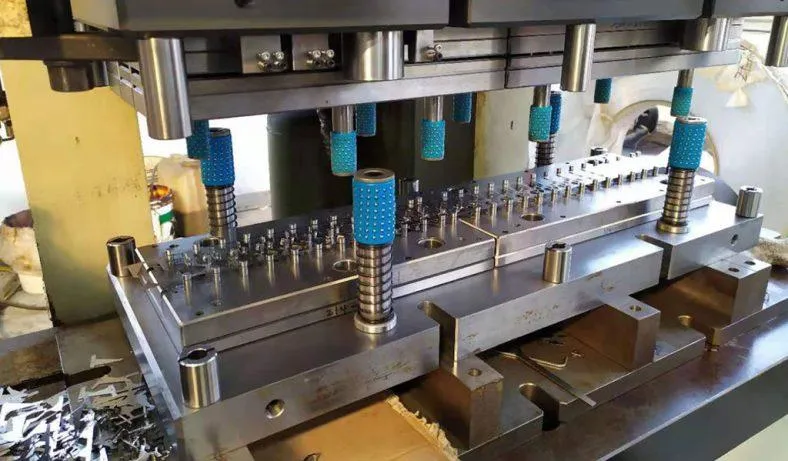
6. Surface Scratches Must Be Controlled
Stainless steel is often selected because of its attractive surface appearance. Consequently, scratches, dents, and other surface defects can become serious quality issues.
During stainless steel stamping, the material may slide across the die surface. Contamination, damaged tooling, poor lubrication, or incorrect material handling can create visible marks.
Tooling surfaces should therefore be properly polished and maintained. Production personnel should also minimize unnecessary contact between the finished surface and hard or contaminated objects.
Protective films may be used for certain applications when surface appearance is critical. Clean production environments and appropriate material handling procedures can further reduce the risk of cosmetic defects.
7. Lubrication Is Particularly Important
Friction has a major influence on forming performance. Without appropriate lubrication, friction between the stainless steel sheet and stamping die can increase significantly.
High friction can cause galling, surface scratches, material tearing, and accelerated tooling wear. Therefore, lubrication is an important part of stainless steel stamping process development.
The lubricant should be selected according to the stainless steel grade, forming operation, production speed, and subsequent cleaning requirements.
For deep drawing and complex forming operations, lubrication becomes even more important because the material may experience substantial sliding and deformation.
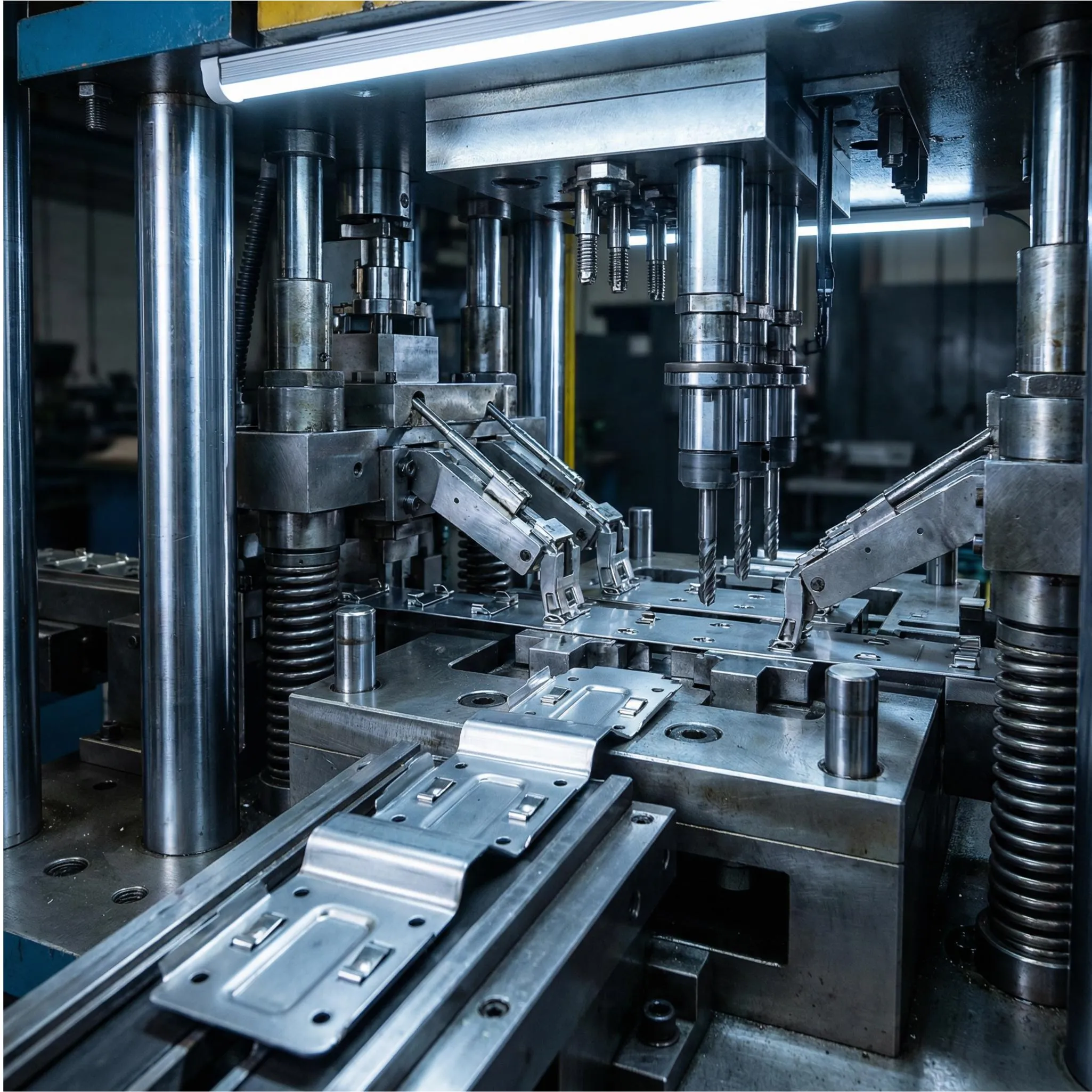
8. Galling Can Damage Both Material and Tooling
Galling is a common concern when working with stainless steel. It occurs when material transfers between contacting metal surfaces under pressure and friction.
During stainless steel stamping, galling can gradually damage the die surface and leave visible marks on the stamped component. Once galling begins, the problem can become progressively worse if production continues without corrective action.
Proper die surface treatment, suitable tooling materials, effective lubrication, and appropriate surface finishing can help reduce this risk.
Tooling engineers should also monitor the die during production and inspect critical forming areas regularly.
9. Accurate Die Design Is Essential
Successful stainless steel stamping starts with accurate die design.
Engineers need to consider material flow, forming direction, blank size, draw beads, punch and die geometry, clearance, forming radius, springback, and part tolerances.
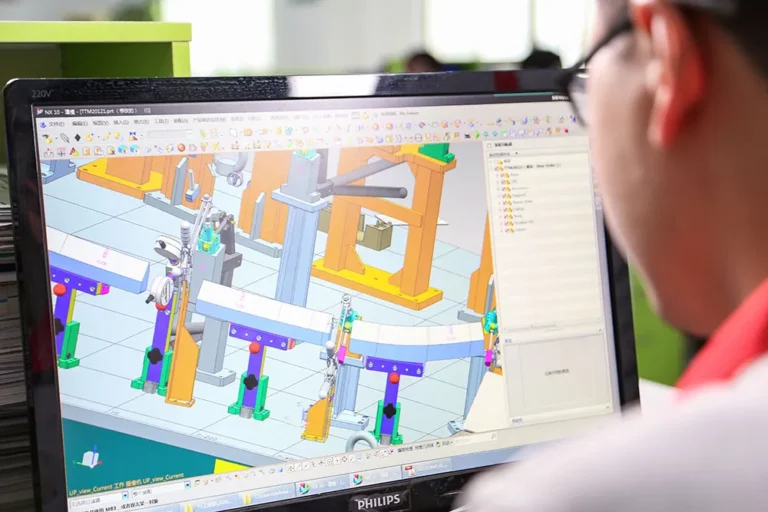
For complex automotive or industrial components, simulation can be used to identify potential forming problems before manufacturing the physical tooling.
Simulation and engineering analysis can help identify areas with excessive thinning, wrinkling, cracking, or insufficient forming capability. Early identification of these issues can reduce die modification costs and shorten the development cycle.
10. Choosing the Right Stamping Process
Not every stainless steel component should be produced using the same stamping method. Depending on component geometry and production requirements, manufacturers may use single-operation dies, progressive dies, transfer dies, compound dies, or other specialized tooling.
For relatively simple components, a single-operation process may provide an economical solution. High-volume small components may benefit from progressive tooling, where several operations are integrated into one continuous production process.
For larger automotive components, transfer stamping can provide greater flexibility for multiple forming operations.
Selecting the appropriate process is one of the most important decisions in stainless steel stamping because it directly affects tooling cost, production efficiency, quality, and cycle time.
11. Press Selection and Production Stability
The stamping press must match the requirements of the component and tooling. Press capacity, stroke length, shut height, speed, bed dimensions, and automation requirements should all be evaluated.
A press that is too small may not provide sufficient forming force, while an oversized machine may increase production costs unnecessarily.
For automated stainless steel stamping, feeding accuracy and synchronization are also important. Stable material feeding helps maintain consistent positioning and reduces the risk of dimensional variation.
12. Quality Control Throughout Production
Quality control should not rely only on final inspection. A reliable stainless steel stamping process requires monitoring from incoming material inspection through die tryout and mass production.
Material certificates should be checked to confirm the correct stainless steel grade and thickness. During die tryout, engineers should inspect dimensions, surface quality, burrs, cracks, wrinkles, and springback.
In mass production, statistical process control and regular dimensional inspection can help identify process changes before they result in large quantities of defective components.
13. How an Experienced Tooling Manufacturer Adds Value
Working with an experienced stamping die manufacturer can significantly reduce the risks associated with stainless steel production.
A capable supplier should understand not only die manufacturing but also material behavior, forming processes, press conditions, tooling maintenance, and quality control.
For stainless steel stamping, engineering experience is particularly valuable because seemingly small changes in die clearance, forming radius, lubrication, or material flow can have a significant impact on final part quality.
At HONGXING, engineering and tooling teams can evaluate component geometry, material requirements, forming operations, and production objectives before developing the stamping die. This engineering-first approach helps manufacturers improve tooling reliability and production consistency.
Conclusion
Stainless steel stamping offers an efficient way to manufacture durable and precise metal components, but the process requires careful engineering. High material strength, work hardening, springback, galling, die wear, surface scratching, burr formation, and lubrication requirements are among the major challenges manufacturers need to address.
Successful production depends on the combination of appropriate material selection, optimized die design, correct press capacity, suitable tooling materials, effective lubrication, controlled forming sequences, and rigorous quality management.
For manufacturers producing automotive components, electrical parts, industrial components, or other precision sheet metal products, selecting the right stamping technology and tooling partner can make a significant difference in production efficiency and product quality.
By applying systematic engineering methods and advanced tooling practices, manufacturers can overcome the challenges associated with stainless steel stamping and achieve stable, repeatable, and cost-effective production.