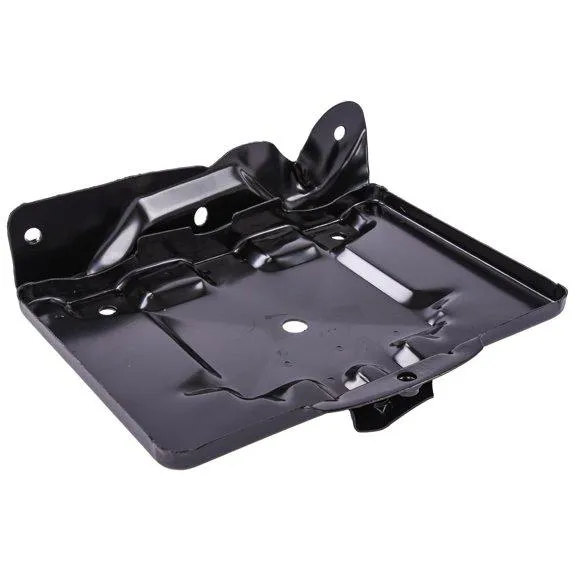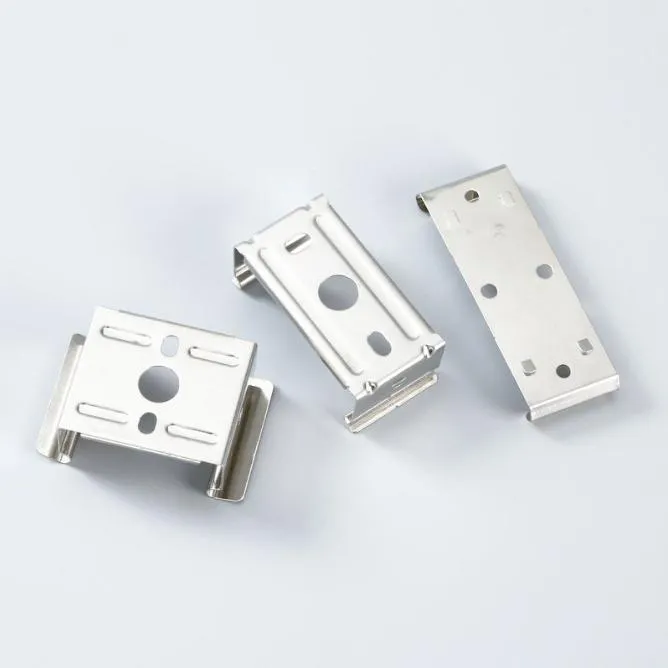


Sheet metal stamping is one of the most widely used manufacturing processes for producing automotive components, structural parts, brackets, housings, and other precision metal products. By using stamping dies and press machines, manufacturers can transform flat metal sheets into components with precise dimensions, complex shapes, holes, flanges, and three-dimensional forms.
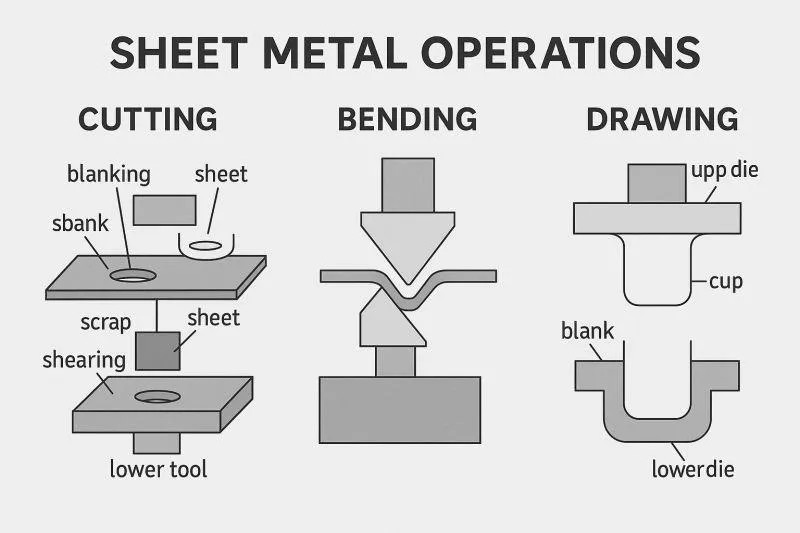
Among the most important operations in the Sheet Metal Stamping Process are blanking, bending, and drawing. Each process performs a different function, and they are often combined to manufacture a complete stamped component.
Understanding the differences between these three processes is important when selecting the right stamping die, designing a production process, or evaluating the manufacturability of an automotive stamping part.
What Is Blanking?
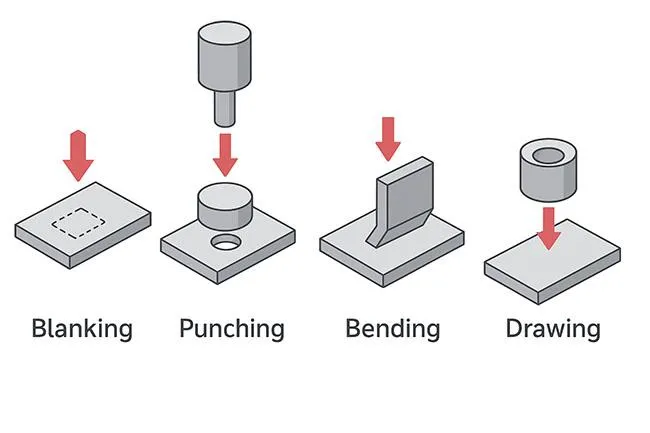
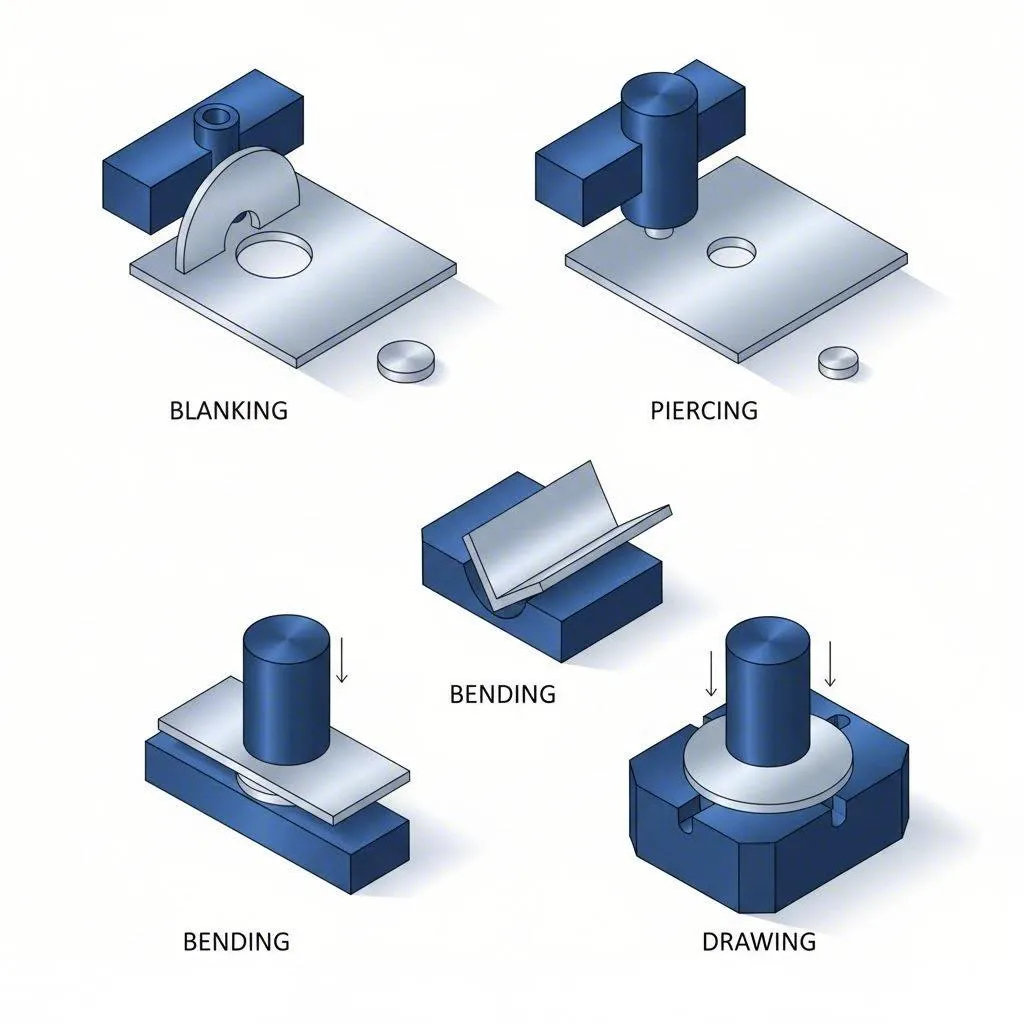
Blanking is a sheet metal cutting operation in which a punch and die separate a desired shape from a metal sheet. The cutting action occurs when the punch moves through the material and creates sufficient shearing force to separate the blank from the surrounding sheet.
The main purpose of blanking is to obtain a piece of sheet metal with a specific external profile that can be used for subsequent stamping operations.
Typical blanking applications include:
- Cutting the basic outline of an automotive component
- Producing blanks for forming and drawing operations
- Creating precise external profiles
- Preparing sheet metal for subsequent stamping operations
Other related cutting operations include piercing, trimming, and cutting. Piercing creates holes in the sheet, while trimming removes excess material after a component has been formed.
In automotive manufacturing, blanking is often the first step before forming a complex component. The size and shape of the blank have a direct influence on material utilization, forming quality, and final part accuracy.
What Is Bending?
Bending is a forming operation that changes the angle or shape of a metal sheet without intentionally separating the material. The stamping press applies force through the punch and die, causing the sheet to undergo plastic deformation.
Unlike blanking, bending does not primarily remove material. Instead, it changes the geometry of the sheet metal.
Typical bending applications include:
- Automotive brackets
- Mounting supports
- Reinforcement components
- Structural sheet metal parts
- Flanges and folded edges
- Battery and chassis components
A related operation is flanging, which forms a raised or folded edge around a component. Flanging is widely used in automotive stamping because it can improve part rigidity, provide mounting surfaces, and help connect different components.
When designing a bending operation, engineers need to consider material thickness, bend radius, springback, forming direction, and tooling clearance. Proper control of these factors is essential for achieving consistent part dimensions.
What Is the Drawing Process?
The Drawing Process is a forming operation used to transform a flat sheet metal blank into a component with depth and a three-dimensional shape.
During drawing, the punch pushes the sheet into the die cavity while a blank holder controls the flow of material. Instead of simply bending the sheet along one line, the material flows into the die cavity and forms a deeper geometry.
The drawing process is commonly used for components such as:
- Automotive door inner panels
- Engine hood components
- Wheel housings
- Body structural parts
- Oil pans
- Battery housings
- Deep sheet metal containers
For automotive body panels, drawing is particularly important because many components contain complex curves, recessed areas, and different forming depths.
Successful drawing requires careful control of material flow. Excessive deformation can cause cracking, while uncontrolled material flow may lead to wrinkles. Engineers therefore need to consider blank shape, draw depth, forming radius, lubrication, blank-holder force, and material properties during die development.
Blanking vs. Bending vs. Drawing
Although blanking, bending, and drawing are all part of the Sheet Metal Stamping Process, their functions are different.
Blanking primarily separates material.
Bending changes the angle or local geometry of the material.
Drawing changes a flat sheet into a deeper three-dimensional shape through controlled material flow.
A simple way to understand the difference is:
Blanking = cutting
Bending = changing the angle
Drawing = creating depth and three-dimensional geometry
In actual automotive production, these operations are rarely considered completely independent. A single component may require several stamping operations before reaching its final geometry.
How These Processes Work Together in Automotive Stamping
A typical automotive stamping component may go through several manufacturing stages.
The process may begin with a flat steel coil or sheet. A blanking operation creates the required blank. The blank is then transferred to a drawing or forming die to create the basic three-dimensional geometry.
Additional forming and bending operations may then refine the component. Piercing operations create mounting or positioning holes, while trimming removes unwanted material around the component. Finally, flanging or other forming operations may create the edges required for assembly.
A simplified production sequence can be:
Blanking → Drawing → Forming → Piercing → Trimming → Flanging → Finished Stamping Part
The actual sequence depends on the component geometry, material, production volume, press capacity, and required dimensional accuracy.
The Role of Stamping Dies
A properly designed stamping die is essential for achieving stable production and consistent part quality. The die controls how the material is cut, formed, drawn, trimmed, or bent during each press cycle.
Depending on the manufacturing requirements, different types of dies may be used, including progressive dies, transfer dies, tandem dies, and single-operation dies.
For complex automotive components, engineers may use multiple dies to gradually achieve the final geometry. This approach helps control material deformation and reduces the risk of defects such as cracks, wrinkles, distortion, and excessive springback.
Die design also needs to consider press tonnage, material properties, die clearance, forming radius, lubrication, material flow, and part positioning.
Common Defects in Stamping Operations
Different stamping processes can produce different types of defects if the tooling or process parameters are not properly controlled.
During blanking, common problems include excessive burrs, dimensional deviation, and poor cutting edges.
During bending, springback is a common challenge. After the forming force is removed, the material may partially return toward its original shape. Die compensation and process optimization are often required to achieve the desired final angle.
During drawing, common problems include wrinkling, cracking, thinning, and distortion. These problems are closely related to material flow, draw depth, blank-holder pressure, forming radius, and material properties.
Therefore, simulation, tryout, measurement, and die correction are important parts of automotive stamping die development.
Why Understanding These Processes Matters
Understanding the difference between blanking, bending, and drawing helps manufacturers select the correct tooling strategy and production sequence.
For automotive manufacturers and Tier 1 suppliers, a well-designed Sheet Metal Stamping Process can provide high production efficiency, repeatable quality, and reduced material waste.
For complex automotive parts, combining blanking, drawing, bending, trimming, piercing, and flanging operations allows manufacturers to produce components with accurate dimensions and complicated geometries while maintaining stable production.
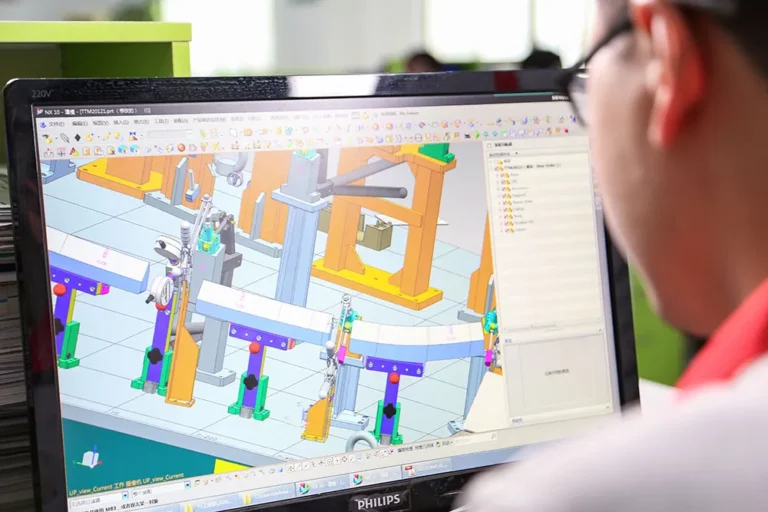
At HONGXING, our manufacturing capabilities cover automotive stamping dies, precision stamping tools, sheet metal stamping, checking fixtures, welding fixtures, and related tooling solutions. Our engineering team can develop stamping solutions according to component geometry, material requirements, production volume, and customer specifications.
Conclusion
Blanking, bending, and drawing are three fundamental operations in modern sheet metal manufacturing.
Blanking separates a required shape from sheet material, bending changes the angle or geometry of the sheet, and the Drawing Process creates depth and three-dimensional shapes through controlled material deformation.
In automotive manufacturing, these processes are often combined with piercing, trimming, forming, and flanging to produce complex body and structural components.
A well-engineered Sheet Metal Stamping Process, supported by high-quality stamping dies and effective process control, is essential for achieving accurate, repeatable, and efficient production.
For manufacturers looking for reliable stamping dies and automotive sheet metal forming solutions, understanding these fundamental processes is the first step toward developing an efficient and stable production system.