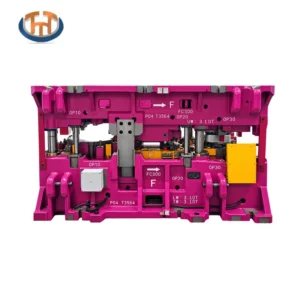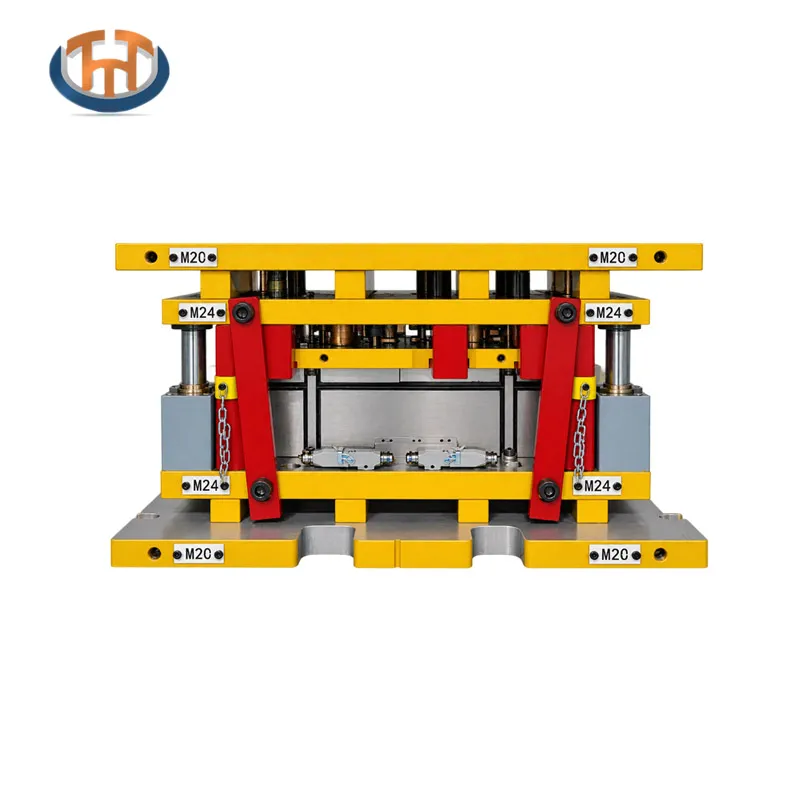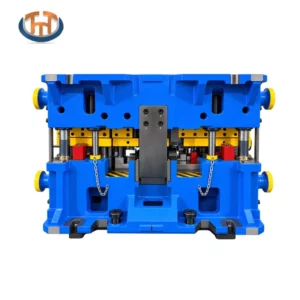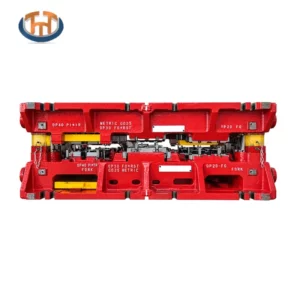

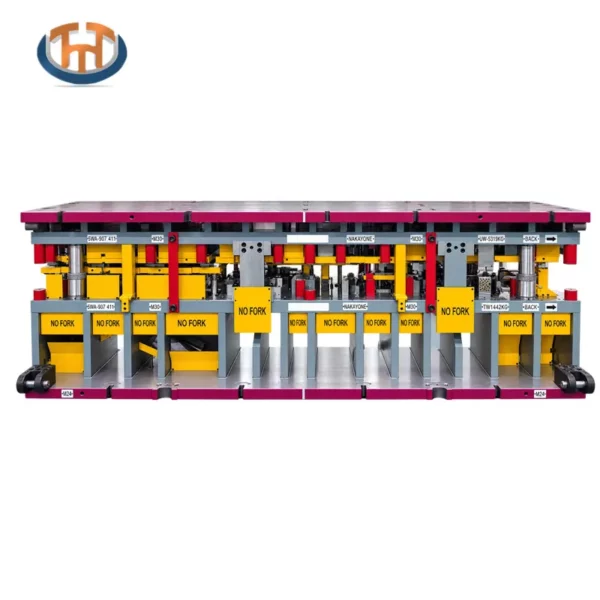
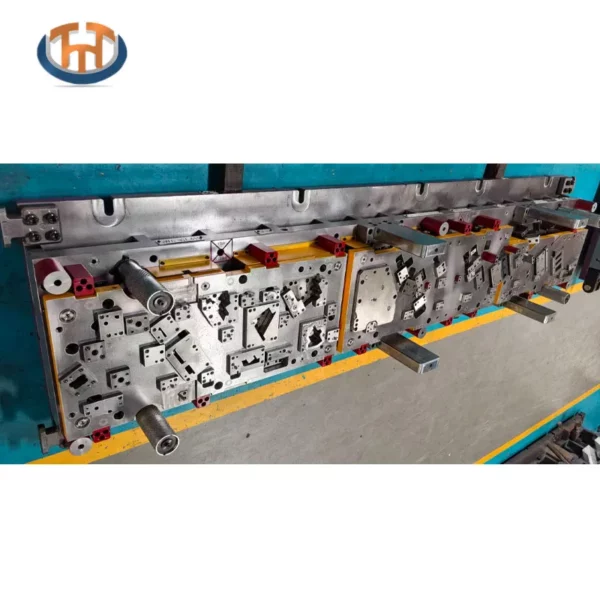
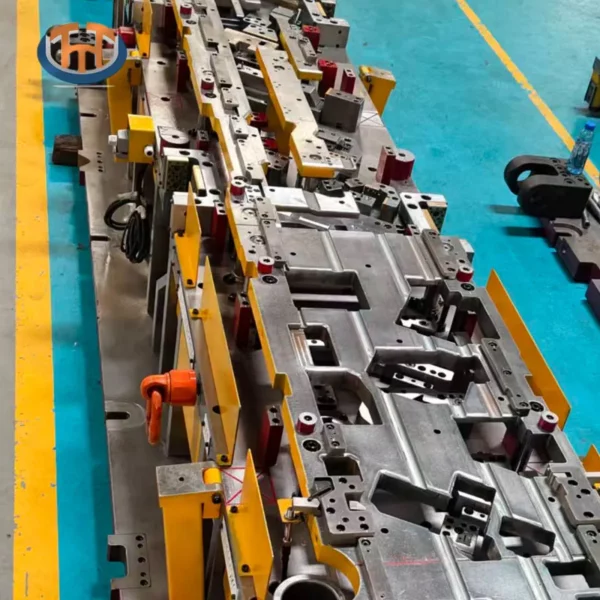
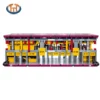
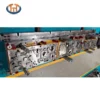
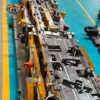
HONGXING Tool & Die manufactures large automotive stamping dies for large and complex sheet metal components used in automotive manufacturing. This project was developed for an automotive protective housing component made from approximately 2.00 mm sheet material.
The tooling is designed for a 1,000-ton press and measures approximately 4,020 × 1,285 × 1,000 mm. The upper die weighs approximately 5,319 kg, while the complete tooling weighs approximately 11,442 kg.
The scale of this tooling requires more than conventional die machining. Engineering, large-format CNC machining, die assembly, fitting, tryout, dimensional inspection, and handling all need to be coordinated around the size and weight of the finished die.
This project represents HONGXING’s experience in manufacturing large automotive tooling for sheet metal components where press capacity, forming geometry, tooling rigidity, and dimensional control are closely connected.
Large Automotive Stamping Die Specifications
| Item | Specification |
|---|---|
| Product Type | Large Automotive Stamping Die |
| Application | Automotive Protective Housing Component |
| Material Thickness | Approx. 2.00 mm |
| Press Capacity | 1,000T |
| Die Size | Approx. 4,020 × 1,285 × 1,000 mm |
| Upper Die Weight | Approx. 5,319 kg |
| Total Tooling Weight | Approx. 11,442 kg |
| Shut Height | 1,000 mm |
| Manufacturer | HONGXING Tool & Die |
| Application | Automotive Sheet Metal Forming |
The final tooling configuration is determined by the component geometry, material properties, press specifications, production requirements, and customer tooling standards.
A Large Die for an Automotive Protective Housing
The component associated with this project is an automotive protective housing formed from approximately 2.00 mm sheet material.
The geometry of a large sheet metal component can create different forming and trimming requirements across the die. The tooling therefore has to maintain the correct relationship between forming surfaces, trimming areas, locating features, and the upper and lower die assemblies.
For this project, the size of the tooling is directly related to the component and the required production process. With an overall length of more than four meters, the die requires appropriate machining capacity and careful control during assembly.
The main tooling considerations include:
- Forming surface geometry
- Material flow
- Die rigidity
- Upper and lower die alignment
- Part positioning
- Forming clearance
- Trimming accuracy
- Dimensional consistency
These considerations are addressed during die engineering, machining, assembly, and tryout.
1,000-Ton Automotive Stamping Tool
The tooling is intended for a 1,000-ton press application, placing substantial demands on the die structure.
The upper die weighs approximately 5.3 tons, and the complete tooling weighs approximately 11.4 tons. Handling a die of this scale requires suitable lifting equipment and manufacturing facilities throughout machining, assembly, inspection, transportation, and installation.
Large-tooling manufacturing also requires careful coordination between individual die components. Machining deviations that may have limited impact on a smaller tool can become more significant when multiple large components are assembled together.
For this reason, HONGXING controls the tooling through a combination of CNC machining, fitting, assembly, tryout, and dimensional inspection.
For other automotive die configurations, HONGXING also manufactures automotive stamping dies for different component geometries and production processes.
Manufacturing a 4,020 mm Long Die
With an overall size of approximately 4,020 × 1,285 × 1,000 mm, this project is a large-format automotive die.
The physical size affects almost every stage of manufacturing. CNC machining requires equipment with sufficient working capacity, while die components must be handled safely during fitting and assembly.
The manufacturing process includes the preparation and machining of individual die components, followed by assembly and adjustment. After assembly, the tooling is evaluated during tryout to identify forming, trimming, alignment, or dimensional issues.
Large automotive dies also require planning for transportation and installation because the completed tooling weighs more than 11 metric tons.
This is one reason why large die manufacturing involves not only machining accuracy but also production planning and heavy-tool handling.
CNC Machining and Die Assembly
The forming surfaces and other functional areas of an automotive stamping die must be machined according to the engineering data.
HONGXING uses CNC machining for die components and forming surfaces before the components are fitted and assembled. During assembly, the upper and lower die structures are checked to establish the required alignment and working clearances.
The subsequent fitting and spotting work helps bring the machined components into their intended working condition.
The manufacturing sequence can include:
- Die engineering and process preparation
- CNC rough machining
- CNC finish machining
- Component fitting
- Die assembly
- Spotting and adjustment
- Press tryout
- Dimensional inspection
- Final tooling verification
The exact sequence depends on the tooling structure and the requirements of the individual project.
3D Dimensional Inspection of the Formed Component
Dimensional inspection provides feedback on the relationship between the manufactured tooling and the finished component.
For this project, HONGXING prepared a 3D inspection report covering multiple inspection characteristics. The inspection data includes points associated with formed surfaces, trim features, hole locations, and other dimensional characteristics.
The inspection documentation includes:
- Reference points
- Nominal dimensions
- Measured dimensions
- Upper and lower tolerances
- Surface inspection points
- Trim inspection points
- Hole inspection points
- Inspection results
Some inspection characteristics use tolerance ranges of approximately ±0.50 mm.
The inspection results can be used during tooling development to identify areas requiring additional adjustment before final validation.
For projects using high-strength sheet materials, HONGXING also manufactures High Strength Steel Stamping Die tooling for automotive applications.
Die Tryout and Tooling Adjustment
Machining and assembly do not represent the end of the tooling development process. The completed die must be evaluated through press tryout.
During tryout, formed components are inspected to determine whether the tooling produces the required geometry and whether any areas require adjustment.
Depending on the inspection results, engineers may adjust forming surfaces, clearances, spotting areas, trimming features, or part positioning.
A typical tryout cycle can involve:
Initial tryout → Part inspection → Dimensional analysis → Die adjustment → Second tryout → Final verification
The process may be repeated until the tooling and formed component meet the defined project requirements.
This approach is particularly relevant to large automotive stamping dies because the tooling contains substantial forming surfaces and multiple functional areas that must work together.
Different Die Processes for Automotive Sheet Metal
The appropriate die configuration depends on the component geometry, production volume, material, and press arrangement.
In addition to large-format tooling, HONGXING manufactures progressive dies, tandem dies, transfer dies, and single-hit dies for different automotive stamping applications.
These die types are not interchangeable. Their configurations are selected according to the production sequence, component geometry, press arrangement, and required manufacturing process.
For large individual components, die size and press capacity can become major engineering considerations, while progressive and transfer processes involve additional requirements related to material movement and multiple forming operations.
HONGXING Large Automotive Tooling Manufacturing
HONGXING Tool & Die specializes in the design and manufacturing of automotive stamping dies.
Our manufacturing work covers large-format tooling as well as dies for structural components, brackets, reinforcement components, and other automotive sheet metal applications.
The main manufacturing stages include:
Engineering → CNC Machining → Assembly → Tryout → Inspection → Final Validation
Tooling can be developed from customer-supplied 2D drawings, 3D CAD data, material specifications, press information, production requirements, and tooling standards.
For this large automotive stamping die project, the combination of a 1,000T press requirement, 4,020 mm tooling length, 5,319 kg upper die, and 11,442 kg total tooling weight illustrates the scale of tooling HONGXING is equipped to manufacture.
TTM Group also provides related automotive manufacturing solutions, including checking fixtures and welding fixtures, through its specialized manufacturing businesses.
Custom Large Automotive Stamping Dies
Large automotive components often require tooling designed around the specific part geometry and available production equipment. Die dimensions, press tonnage, material thickness, forming requirements, and inspection criteria can vary considerably between projects.
HONGXING manufactures custom automotive stamping dies according to the requirements of each component and production program.
If you are developing a large sheet metal component and require a large automotive stamping die, HONGXING can review your part drawing, 3D CAD model, material information, press specifications, and production requirements.
Request a Quote for your automotive stamping die project and provide the available technical information for engineering evaluation.