

| Automotive Stamping Die Springback: How to Control It |
Springback is one of the most common dimensional challenges in automotive sheet metal forming. After a stamped component is released from the forming die, the material may partially return toward its original shape because of elastic recovery. Even when the die itself has been manufactured accurately, springback can cause dimensional deviation in the finished component.
For automotive manufacturers and Tier 1 suppliers, controlling springback is particularly important for body panels, structural reinforcements, brackets, cross members, battery-related components, and other precision sheet metal parts.
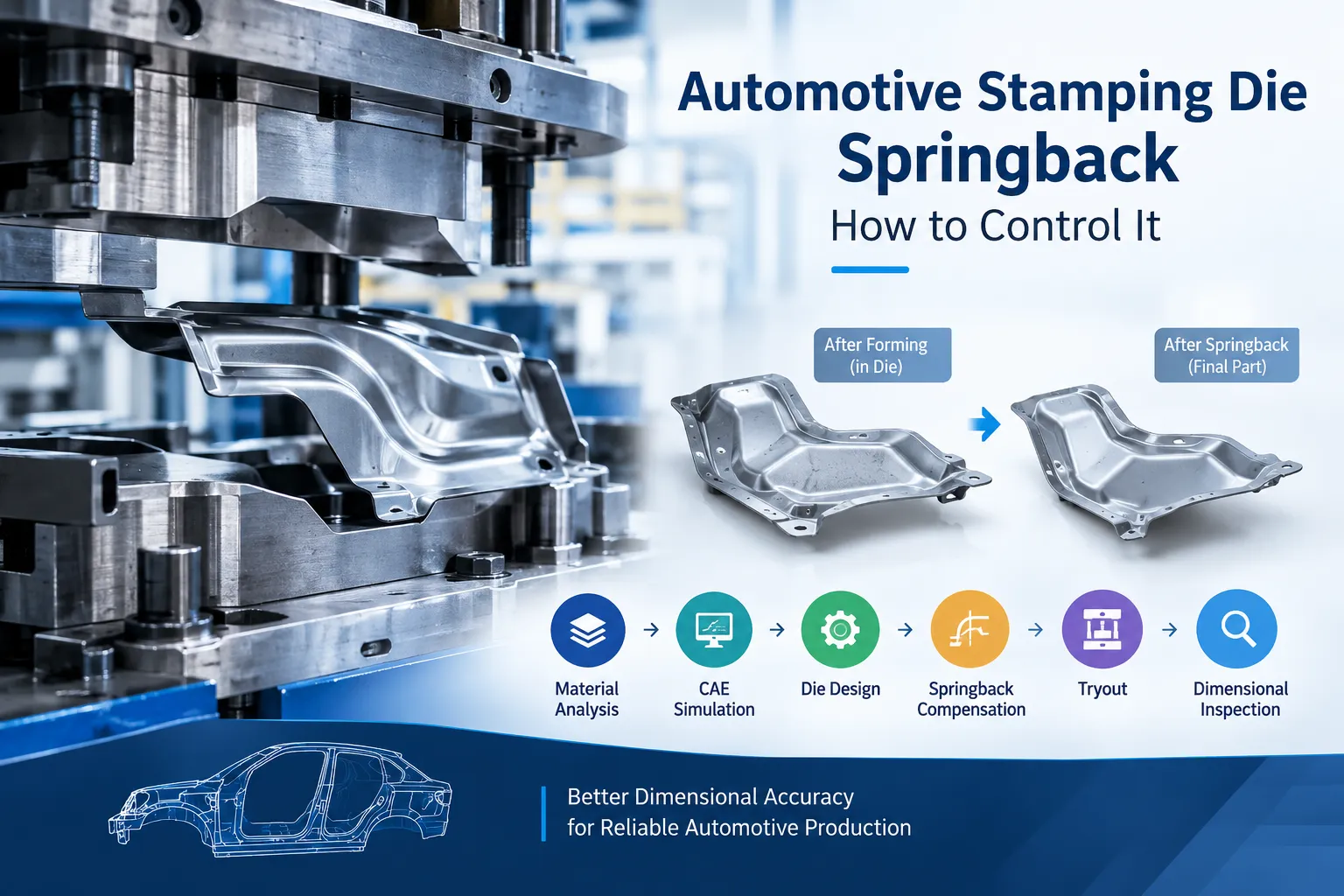
The key to controlling springback is not simply increasing machining accuracy. Effective springback control requires a combination of material analysis, forming process development, die design, compensation, tryout, and dimensional verification.
What Is Springback in Automotive Stamping?
Springback occurs when elastic stresses remaining in sheet metal are released after the forming force is removed.
During stamping, the material experiences a combination of tension, compression, bending, and plastic deformation. When the component leaves the die, some elastic deformation recovers.
This recovery can change:
- Bend angles
- Flange positions
- Surface contours
- Hole locations
- Part dimensions
- Assembly relationships
The amount of springback depends on several variables, including material strength, sheet thickness, forming geometry, bend radius, friction, forming direction, and process conditions.
Understanding the relationship between material behavior and tooling geometry is therefore an important part of automotive stamping die design.
Why Springback Matters in Automotive Manufacturing
A small dimensional deviation may appear acceptable when a component is inspected individually. However, the same deviation can become more significant during vehicle assembly.
For example, springback may affect the relationship between:
- Structural panels
- Reinforcement components
- Mounting brackets
- Welding points
- Locating holes
- Flanges
- Adjacent body components
If the stamped component does not match the intended geometry, additional correction or adjustment may be required during assembly.
For high-volume automotive production, uncontrolled springback can therefore lead to increased die correction work, dimensional variation, production interruptions, and additional manufacturing costs.
1. Understand Material Behavior Before Die Design
Springback control should begin before the physical stamping die is manufactured.
The engineering team should evaluate the material grade, thickness, yield strength, tensile strength, elongation, and forming characteristics.
Different materials can behave very differently during forming.
For example:
- Mild steel generally has relatively good formability.
- High-strength steel can generate greater springback.
- Advanced high-strength steel may require more advanced compensation strategies.
- Aluminum alloys have different elastic and forming characteristics from steel.
Material thickness also influences forming behavior. Therefore, springback analysis should consider both the material grade and actual sheet thickness specified for production.
For complex automotive components, the material selection and forming strategy should also be considered together with the requirements of the final automotive stamping parts.
2. Optimize the Forming Geometry
The geometry of the component has a direct influence on springback.
Important design factors include:
- Bend radius
- Forming depth
- Flange geometry
- Wall angle
- Curvature
- Feature location
- Transition areas
Sharp changes in geometry can create uneven stress distribution within the sheet.
During automotive die development, engineers can modify forming geometry where necessary to create a more stable deformation pattern.
The objective is not simply to reproduce the nominal CAD surface inside the die. The tooling must also account for how the material behaves when the forming force is released.
This is one reason why the principles discussed in stamping die basic structure should be considered together with the actual forming requirements of the component.
3. Control Material Flow
Material flow is another important factor in springback control.
During forming, different areas of the sheet may experience different levels of stretching and compression. If material flow is poorly controlled, the resulting stress distribution may increase dimensional variation after unloading.
Depending on the component, engineers may evaluate:
- Blank geometry
- Forming sequence
- Draw beads
- Blank-holder conditions
- Friction
- Forming direction
- Material feeding
- Local reinforcement features
A stable forming process helps create more predictable deformation and makes dimensional correction easier during tryout.
For deep-drawn automotive components, controlling material flow is particularly important because uneven deformation can create both dimensional deviation and other forming problems.
4. Use CAE Simulation for Springback Prediction
Modern automotive stamping die development can use CAE simulation to identify potential springback problems before manufacturing the physical tool.
Simulation can help engineers evaluate:
- Material deformation
- Stress distribution
- Thickness changes
- Forming feasibility
- Springback direction
- Potential dimensional deviation
- High-risk forming areas
Instead of waiting until the first physical tryout to discover dimensional problems, engineering teams can use simulation results to identify potential problem areas earlier.
Simulation is especially useful when developing tooling for complex automotive structural components or parts manufactured from high-strength materials.
Instead of treating simulation as an isolated step, it should be connected with automotive stamping die manufacturing so that the predicted forming behavior can be considered during actual tooling development.
However, simulation should be considered an engineering tool rather than a substitute for physical validation. Material variation, actual press conditions, friction, tooling conditions, and production parameters can influence real-world results.
5. Apply Springback Compensation in Die Design
Springback compensation is one of the most important techniques used to control dimensional deviation.
The basic concept is to intentionally modify the forming geometry so that the stamped component moves toward the required final shape after elastic recovery.
For example, if a formed surface consistently springs away from the nominal geometry after unloading, the tooling geometry can be adjusted in the opposite direction.
This compensation may involve:
- Surface compensation
- Angle compensation
- Flange compensation
- Forming profile adjustment
- Local geometry modification
The amount of compensation should be based on engineering analysis, simulation, tryout results, and dimensional inspection rather than arbitrary adjustment.
For difficult forming applications, the compensation strategy should be established before final die surfaces are released for manufacturing.
6. Pay Attention to High-Strength Steel
The increasing use of high-strength steel in automotive manufacturing has made springback control even more important.
High-strength materials can provide excellent structural performance and help reduce vehicle weight, but they can also introduce more demanding forming conditions.
Potential challenges include:
- Greater springback
- Higher forming loads
- Increased tool loading
- Greater sensitivity to process variation
- More difficult dimensional control
Therefore, the die structure, forming sequence, material flow, and compensation strategy should be developed according to the actual material characteristics.
A tooling solution that works well for mild steel may not provide the same dimensional performance when applied to a high-strength steel component.
For applications involving structural automotive components, a dedicated automotive structural stamping die may require a different engineering approach from conventional sheet metal tooling.
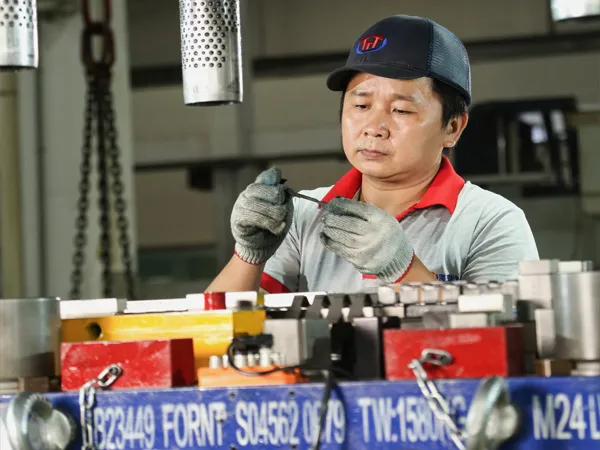
7. Use Tryout to Validate the Actual Tool
Even when simulation and die design are carefully completed, physical tryout remains an essential part of automotive stamping die development.
During tryout, engineers can evaluate the actual component under production-related conditions.
The process may include:
- Initial stamping
- Part dimensional inspection
- Identification of deviation areas
- Comparison with CAD data
- Tool correction
- Additional stamping
- Final dimensional verification
This iterative process helps bridge the gap between theoretical design and actual production behavior.
For complex automotive components, several correction cycles may be required before the tooling achieves the required dimensional performance.
An experienced stamping die manufacturer can use tryout results to identify the source of dimensional deviation and determine whether changes are required to the forming surface, process parameters, or die components.
8. Use Dimensional Inspection to Close the Loop
Springback control should be connected to a reliable dimensional inspection process.
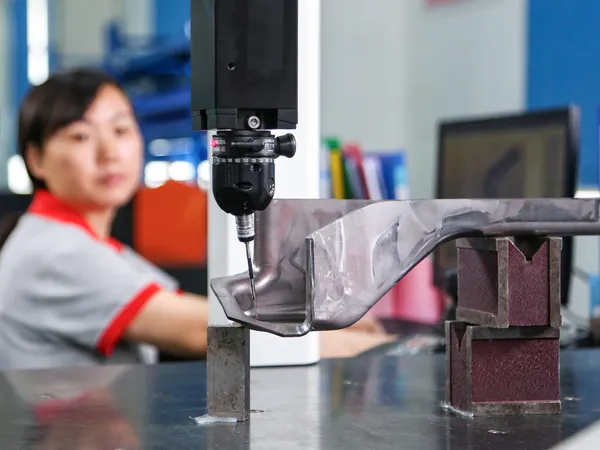
Inspection methods may include CMM measurement, 3D scanning, gauge inspection, and other dimensional verification methods depending on the component and customer requirements.
Inspection results can help engineers determine whether dimensional deviation originates from:
- Tool geometry
- Material behavior
- Forming conditions
- Assembly conditions
- Springback
- Tool alignment
- Process variation
The objective is not simply to identify that a part is out of tolerance. The inspection data should help identify the reason for the deviation so that an effective tooling correction can be made.
Dimensional variation should also be considered together with tolerance stack-up in automotive manufacturing when multiple components must work together during vehicle assembly.
Springback Control Is a Systematic Engineering Process
There is no single adjustment that can eliminate springback from every automotive stamping application.
A reliable approach combines:
Material Analysis → Process Development → CAE Simulation → Die Design → Springback Compensation → Tryout → Dimensional Inspection → Tool Correction
This closed-loop development process allows engineers to progressively improve the dimensional accuracy of the stamped component.
For complex automotive tooling projects, springback should therefore be considered during the earliest stages of product and process development rather than treated as a problem that appears only during final tryout.
How HONGXING Controls Springback in Automotive Stamping Dies
HONGXING provides automotive stamping die engineering and manufacturing solutions for automotive manufacturers and Tier 1 suppliers.
Our tooling development process integrates engineering analysis, die design, precision machining, assembly, tryout, correction, and dimensional verification.
Depending on the project, HONGXING can develop tooling solutions for:
- Automotive body components
- Structural reinforcements
- Cross members
- Brackets
- Battery-related components
- Sheet metal structural parts
- High-strength steel components
- Complex formed automotive components
Our tooling development capabilities cover progressive dies, transfer dies, tandem dies, and customized stamping tooling.
By combining engineering analysis with precision manufacturing and physical tryout, HONGXING aims to help customers achieve stable dimensional performance and reliable mass production.
Conclusion
Springback is a fundamental dimensional challenge in automotive sheet metal forming, particularly when producing complex components from high-strength materials.
Effective control requires more than simply improving die machining accuracy. Material characteristics, forming geometry, material flow, process conditions, CAE analysis, springback compensation, physical tryout, and dimensional inspection all contribute to the final result.
A well-developed automotive stamping die should therefore be designed around the complete forming process rather than the nominal CAD geometry alone.
For automotive manufacturers developing new sheet metal components, early springback analysis can help reduce tooling modifications, improve dimensional consistency, and support a smoother transition from tooling development to mass production.
If you are developing a new automotive stamping project, HONGXING can evaluate your component geometry, material, thickness, production requirements, and press conditions to recommend an appropriate tooling approach.
Request a Quote for your automotive stamping die project and discuss your tooling requirements with the HONGXING engineering team.